
Lucasfilm
It’s a very big week leading up to the lucrative Christmas holiday, as well as the penultimate week for awards consideration so the studios, particularly in the later decades, are rolling out their big guns. Not everything was a success though. A 1935 film nearly ended the Civil War film genre … but Bette Davis saved it three years later. 1945 had an Oscar-nominated war movie from an iconic director, and an Oscar-winning animated short starring a popular cat and mouse team. Despite some serious miscasting, a 1955 musical received some Oscar notice while the Golden Globes were feeling a little more generous. A Russian-set 1965 drama earned several Oscar noms but no wins, and won all but one of its six Golden Globe nominations. 1965 also saw the release of the fourth film in a popular British secret agent series, also being awarded an Oscar for its visual effects. 1975 saw another iconic director get his fourth and final Oscar nomination, while another big name director was snubbed for an Oscar nomination while his film earned 11 nominations — with no wins. A presidential 1995 film got Oscar, BAFTA and Golden Globe nominations, but came up empty, and the snubbed 1985 director scored a nominations in 2005, but still left the ceremony empty-handed. And 2015 saw the resurrection of a popular sci-fi film series that also scored several Oscar nominations but the Force was not with it this time. Scroll down to see all of the films released this week and tell us if any of your favorites are celebrating milestone anniversaries.
1925
- December 19 – Pleasure Buyers (USA, Warner Bros. Pictures)
- December 19 – Tonio, Son of the Sierras (USA, J. Charles Davis Productions)
- December 20 – Soul Mates (USA, Metro-Goldwyn-Mayer)
- December 20 – The Prince of Pep (USA, Carlos Productions)
- December 20 – The Ship of Souls (USA, Encore Pictures-Stereoscopic Film Company)
- December 20 – Triple Action (USA, Blue Streak Western)
- December 21 – Steel Preferred (New York City, Metropolitan Pictures Corporation of California)
- December 22 – A Kiss for Cinderella (USA, Famous Players-Lasky Corporation)
- December 22 – The Call of Courage (USA, Blue Streak Western)
- December 23 – A Streak of Luck (USA, Action Pictures)
- December 23 – Ermine and Rhinestones (USA, Burton King Productions)
Steel Preferred expanded to wide release in the US on January 3, 1926.
The survival statues of Tonio, Son of the Sierras, Triple Action, The Call of Courage, A Streak of Luck and Ermine and Rhinestones are unknown, while The Ship of Souls and Steel Preferred are considered lost films.
A print of The Pleasure Buyers is held at Museum of Modern Art. Soul Mates was saved by MGM with a preservation print, probably located at the George Eastman House. Prints of The Prince of Pep are held by the Library of Congress, Cinematheque Royale de Belgique, and Academy Film Archive.
The Ship of Souls was filmed in a 3D process created by the film’s producer, Max O. Miller.
Prints of A Kiss for Cinderella are preserved at the Museum of Modern Art, New York, George Eastman Museum Motion Picture Collection, UCLA Film and Television Archive, and the foreign archive Cinematheque Royale de Belgique (Brussels).
1935
- December 18 – Whipsaw (USA, Metro-Goldwyn-Mayer)
- December 20 – Another Face (USA, RKO Radio Pictures)
- December 20 – Last of the Pagans (USA, Metro-Goldwyn-Mayer)
- December 20 – So Red the Rose (USA, Paramount Pictures)
- December 20 – Too Tough to Kill (USA, Columbia Pictures)
- December 20 – Trail of Terror (USA, Supreme Pictures)
- December 21 – Man of Iron (USA, First National Pictures)
- December 24 – Hong Kong Nights (USA, Walter Futter Productions)
Whipsaw was intended to star Myrna Loy and William Powell, but Powell was unavailable and Spencer Tracy was called in to replace him. The film’s original title was to be Unexpected Bride. One scene featured Loy without makeup and her hair unkempt. MGM executives chastised cinematographer James Wong Howe for doing this as the studio had spent millions glamorizing the actress. The scene was cut from the film. It has been said that Loy and Tracy had a secret affair while filming, though in Loy’s autobiography she wrote that he had fallen in love and harassed her during production. The affair ended with the film, but resumed a year later when they made Libeled Lady.
Another Face was released in the UK as It Happened in Hollywood. Last of the Pagans is based on the Herman Melville novel Typee (1846).
Civil War film So Red the Rose was so unpopular at the box office that Civil War films were considered box office poison until Bette Davis’ Jezebel was a success in 1938, followed by Gone With the Wind in 1939. Robert Cummings was offered a long-term contract with Paramount after being cast in the film.
1945
- December 19 – The Stork Club (USA, New York City, B.G. DeSylva Productions Inc.)
- December 20 – Dick Tracy (USA, RKO Radio Pictures)
- December 20 – Texas Panhandle (USA, Columbia Pictures)
- December 20 – They Were Expendable (USA, Metro-Goldwyn-Mayer)
- December 21 – Wagon Wheels Westward (USA, Republic Pictures)
- December 22 – Quiet Please! (USA, short, Metro-Goldwyn-Mayer)
- December 24 – How Doooo You Do!!! (USA, Producers Releasing Corporation)
- December 24 – Old Mother Riley at Home (UK, British National Films)
The Stork Club entered wide release in the US on December 28, 1945. Old Mother Riley at Home has no known US theatrical release date.
Dick Tracy is also known as Dick Tracy, Detective. It is the first of four Dick Tracy films from RKO. Obtaining the rights to the character from creator Chester Gould cost the studio $10,000 (about $180,000 today). Texas Panhandle was the eighth of 65 films in the Durango Kid series.
MGM wanted John Ford to direct They Were Expendable, but he initially refused due to conflicts with his own service in the Navy Field Photographic Unit. He eventually agreed to take on the project. During production, Ford fell from scaffolding and broke his leg. He asked actor Robert Montgomery, who had actually commanded a PT boat, to take over while he recovered. Montgomery did so well that within a few years he transitioned completely from acting to directing. The film received an Oscar nominations for Best Sound Recording.
Quiet Please! is the 22nd Tom & Jerry short. It won the Oscar for Best Animated Short. Old Mother Riley at Home is the 11th film in the long-running Old Mother Riley series.
1955
Samuel Goldwyn Productions
- December 21 – All for Mary (UK, Paul Soskin Productions)
- December 21 – The Indian Fighter (USA, New York City, Bryna Productions)
- December 21 – Top Gun (USA, Fame Pictures)
- December 23 – Guys and Dolls (USA, Samuel Goldwyn Productions)
- December 23 – It’s a Dog’s Life (USA, Metro-Goldwyn-Mayer)
- December 23 – Kismet (USA, Metro-Goldwyn-Mayer)
- December 23 – The Spoilers (USA, Universal International Pictures)
All for Mary has no known US theatrical release date. The Indian Fighter opened in wide release in the US on April 27, 1956.
Top Gun features Australian actor Rod Taylor in one of his first American roles. The film has been remade as Noose for a Gunman and The Quick Gun.
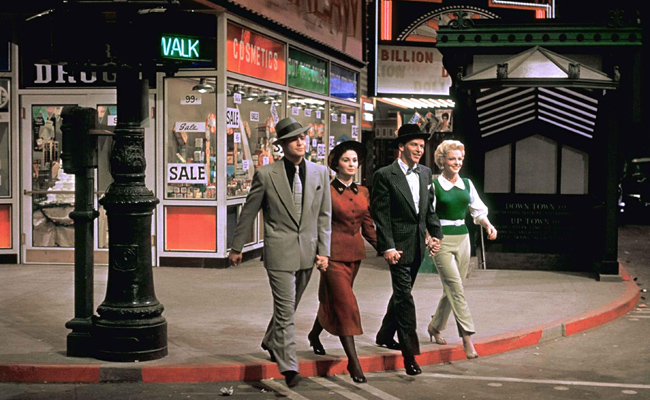
Michael Kidd, who staged the dances for the Broadway production, choreographed the dances for the film adaptation of Guys and Dolls. Gene Kelly was a serious contender for the role of Sky Masterson, played by Robert Alda on Broadway, but Marlon Brando was cast because MGM would not loan Kelly out for the production. Producer Samuel Goldwyn also wanted to cast Brando because he was the world’s biggest box office draw at the time. Frank Sinatra wanted the role badly, and Brando’s casting strained their relationship. Sinatra had also lost the role of Terry Malloy in On the Waterfront to Brando. Sinatra referred to Brando while filming as ‘Mumbles’. In a bit of irony, the film ended up being distributed by Kelly’s home studio. Sinatra was cast as Nathan Detroit, but director Joseph Mankiewicz said only Laurence Olivier could have been more miscast than Sinatra, who played the Jewish character as a ‘dapper Italian swinger’. The role had been written for Sam Levene, who played the role on Broadway. Goldwyn said a Jew playing a Jew on screen would never work so Sinatra was cast over Mankiewicz’s objections. Composer and lyricist Frank Loesser objected to Sinatra’s casting to the point that when he died in 1969 he had still never watched the movie. Betty Grable was considered for the role of Miss Adelaide, but she was unavailable so Vivian Blaine, who originated the role on stage, was cast. Marilyn Monroe had campaigned for the role but not even a call to the director would change his mind. Stubby Kaye, B.S. Pully and Johnny Silver also reprised their Broadway roles. Goldwyn wanted Grace Kelly for the role of Sarah Brown, but she turned it down. Deborah Kerr was contacted but she was unavailable. Third choice Jean Simmons had already worked with Brando, and she surprised everyone with her singing voice. After seeing the dailies, Goldwyn exclaimed that he was happy he couldn’t get Kelly. The film earned four Oscar nominations in technical categories, and two BAFTAs for Best Film from Any Source and Best Foreign Actress (Simmons). It was nominated for, and won, two Golden Globes for Best Picture – Musical or Comedy, and Best Actress in a Motion Picture – Musical or Comedy. A remake to be directed by Rob Marshall has been in development since 2024.
Kismet is the fifth version of the story, following adaptations of the 1911 play in 1914, 1920, 1930, 1944. The 1955 film is the only musical version, based on the 1953 stage production. The Spoilers is the fifth, and to date last, adaptation of Rex Beach’s novel of the same name.
1965
- December 21 – Up Jumped a Swagman (UK, Ivy Films)
- December 22 – Boeing Boeing (USA, Wallis-Hazen)
- December 22 – Do Not Disturb (USA, Melcher-Arcola Productions)
- December 22 – Doctor Zhivago (New York City, Carlo Ponti Productions)
- December 22 – Inside Daisy Clover (USA, Park Place Productions)
- December 22 – Thunderball (USA, Eon Productions)
- December 23 – The Slender Thread (USA, Stephen Alexander Productions)
- December 24 – Bad Girls Go to Hell (USA, Juri Productions)
Up Jumped a Swagman has no known US theatrical release date. Doctor Zhivago opened in wide release in the US on December 31, 1965. Thunderball first opened in South Africa on December 9, 1965.
Up Jumped a Swagman features the film debut of Suzy Kendall, who replaced the original leading lady when she became pregnant before shooting started.
Boeing Boeing was the last film Jerry Lewis made for Paramount, which had produced all of his films since 1949’s My Friend Irma. Director John Rich did not think a European hit play that poked fun at American sexual proclivities in the jet age would be appreciated by American audiences, but producer Hal Wallis disagreed. Rich also would have preferred Jack Lemmon or Dick Van Dyke instead of Lewis, fearing Lewis would fall back on his familiar brand of comedy instead of aiming for an honest performance, but Wallis insisted on Lewis. Rich was fine with co-star Tony Curtis. Lewis did misbehave initially, but Rich threatened him and they forged a mutual working relationship. Curtis and Lewis both wanted top billing so their names spin around in a circle during the opening credits. Their names appear making an X on the poster. This was one of the first films in which the audience heard Lewis’ normal speaking voice.
Boris Pasternak’s novel, Doctor Zhivago, had been banned in Russia so the film could not be made on location. Spain was chosen as a stand-in. Producer Carlo Ponti wanted to make the film as a starring vehicle for his wife, Sophia Loren. Omar Sharif was the first actor cast, but he wanted to play the role of Pasha. His Lawrence of Arabia co-star, Peter O’Toole, was director David Lean’s first choice to play Zhivago but he turned it down. Sharif was surprised when he was offered the role. The role of Pasha went to Tom Courtenay. Max von Sydown, Paul Newman, Rod Taylor and Michael Caine had also been considered for Zhivago, but after seeing his screen shots with Julie Christie, Caine was the one who suggested Sharif for the role. Marlon Brando and James Mason turned down the role of Komarovsky, so Rod Steiger was cast. Lean convinced Ponti that Loren was not right for the role of Lara — saying she was too tall, but privately he felt no one would believes she was a virgin in the early part of the film. Jeanne Moreau, Yvette Mimieuz, Sarah Miles and Jane Fonda were considered, but Julie Christie was cast based on her performance in Billy Liar, and on the recommendation of Jack Cardiff, who directed her in Young Cassidy. Sharif’s son Tarek played the young Zhivago, and Sharif directed him as a way to get closer to his character. Lean chose Spain because he knew there would be snow in some parts, but they faced the country’s warmest weather in 50 years so some scenes were filmed on stages with artificial snow. Some winter scenes were filmed in Finland and Canada. Nicholas Roeg was the original director of photography, but was replaced with Freddie Young after an argument with Lean. The film earned 10 Oscar nominations including Best Picture and Director, winning for Adapted Screenplay, Color Art Direction, Color Cinematography, Color Costume Design, and Original Score. It received three BAFTA nominations. It also received six Golden Globe nominations, winning five for Motion Picture – Drama, Actor (Sharif), Director, Screenplay, and Original Score. Maurice Jarre’s music also received three Grammy nominations, winning for Best Original Score.
Inside Daisy Clover was nominated for three Oscars and three Golden Globes. It won two Globes for Supporting Actress (Ruth Gordon) and Most Promising Newcomer – Male (Robert Redford).
Thunderball is the fourth film in the James Bond franchise. It was the first Bond film shot in widescreen Panavision, and the first to have a running time over two hours. It had originally been planned as the first film in the series, but a legal dispute between Ian Fleming, Kevin McClory and Jack Whittington claiming that Fleming had based his novel on a screenplay the three had written, caused the film to be delayed. McClory retained the rights to certain story elements and characters — like Blofeld — and he executive produced a remake titled Never Say Never Again, with Sean Connery back as Bond, in 1983. McClory’s rights have reverted back to Eon Productions, which allowed the Blofeld character to appear in Spectre and No Time to Die. Producer Albert Broccoli wanted Julie Christie to play Domino Derval, but after meeting her changed his mind and set his sights on Raquel Welch. Welch had already signed to be in Fantasic Voyage, so Faye Dunaway was approached and nearly took the role. After an extensive list of auditions with relative unknowns, former Miss France Claudine Auger was cast, and the part was rewritten to be French rather than Italian, although her dialogue was dubbed by Nikki van der Zyl. Guy Hamilton was asked to direct but he felt ‘creatively drained’ after directing Goldfinger so Terence Young, who directed the first two Bond film, returned. It would be his last Bond film. Special effects supervisor John Stears had been given experimental rocket fuel to use for the explosion of Largo’s yacht. Unaware of the true power of the volatile liquid, he doused the yacht with it, took cover and detonated the boat, shattering windows nearly 30 miles away. Stears won an Academy Award for his work. The film’s original theme song was titled ‘Mr. Kiss Kiss Bang Bang’, the name an Italian journalist had given Bond in 1962. Shirley Bassey recorded the song but it was too short for the opening credits and she was unavailable to re-record it. Dionne Warwick recorded a new version with a longer instrumental section, but producers then feared a theme song without the title of the film would not work, so composer John Barry — working on his third Bond film — and lyricist Don Black wrote ‘Thunderball’, which was recorded by Tom Jones. Jones is said to have fainted while singing the song’s final note. Warwick’s recording was finally released in the 1990s. Johnny Cash is said to have submitted a song to the producers titled ‘Thunderball’ but it was not used.
The Slender Thread was the first feature-length film directed by Sydney Pollack. The film’s original screenplay was titled Voice in the Wind and was submitted to MGM, but it was rejected due to creative differences. Paramount acquired the script, cast Sidney Poitier, and changed the title to Call Me Back. Elizabeth Ashley was cast as the female lead, but then learned through a third party that she had been replaced with Anne Bancroft without formal notice. Ashley sued the studio because she had turned down a more lucrative project worth $100,000 to make the film. The case was eventually settled out of court. When production began in June 1965, Paramount changed the title again to The Slender Thread due to negotiations with NBC for a television project titled Call Me Back. During production, Poitier acted on a soundstage while Bancroft read her lines off stage or through a receiver in her dressing room with a live microphone. The film earned two Oscar nominations for Art Direction-Set Decoration, Black-and-White, and Costume Design, Black-and-White.
1975

Peregrine-Hawk Films
- December 18 – Barry Lyndon (USA/Canada/UK, Peregrine-Hawk Films)
- December 19 – Bugs Bunny: Superstar (USA, Hare-Raising Films)
- December 19 – Carry On Behind (UK, Peter Rogers Productions)
- December 19 – Hedda (UK, Bowden Productions Ltd.)
- December 19 – The Adventures of the Wilderness Family (USA, Pacific International Pictures)
- December 19 – The Killer Elite (USA, Arthur Lewis-Baum/Dantine Productions)
- December 19 – The Man Who Would Be King (USA/UK, Devon/Persky Bright Features)
- December 20 – Seven Beauties (Italy, Medusa Distribuzione)
- December 22 – The Story of Adele H. (USA, limited, Les Films du Carrosse-Les Productions Artistes Associés)
Carry On Behind was released in the US on April 2, 1976. Seven Beauties was released in the US on January 21, 1976. The Story of Adele H. first opened in France on October 8, 1975.
1985
- December 18 – Out of Africa (USA, limited, Mirage Enterprises)
- December 18 – The Color Purple (USA, limited/Canada, Amblin Entertainment)
- December 20 – A Chorus Line (USA, A Feuer and Martin Production)
- December 20 – Enemy Mine (USA, Kings Road Entertainment)
- December 20 – Ran (USA, Kurosawa Production Co.)
Out of Africa first opened in Turkey on December 10, 1985, and went into wide release in the US and Canada on December 20. The Color Purple entered wide release in the US on February 7, 1986. A Chorus Line first opened in Argentina on December 12, 1985. Enemy Mine first opened in West Germany on December 12, 1985. Ran first opened in Japan on June 1, 1985.
1995
- December 19 – Magic Island (USA, Moonbeam Entertainment)
- December 20 – Nixon (USA, limited, Illusion Entertainment)
- December 22 – Balto (USA/Canada, Amblin Entertainment)
- December 22 – Cutthroat Island (USA, Beckner/Gorman Productions)
- December 22 – Dracula: Dead and Loving It (USA, Brooksfilm)
- December 22 – Grumpier Old Men (USA, Lancaster Gate)
- December 22 – Sudden Death (USA/Canada, Signature/Baldwin Cohen Productions)
- December 22 – Tom and Huck (USA, Painted Fence Productions)
- December 22 – Waiting to Exhale (USA, 20th Century Fox)
Nixon expanded nationwide in the US on January 5, 1996. Sudden Death first opened in Mexico on October 26, 1995.
2005

Amblin Entertainment
- December 21 – Cheaper by the Dozen 2 (USA/Canada, 21 Laps Entertainment)
- December 21 – Fun with Dick and Jane (USA/Canada, JC 23 Entertainment)
- December 21 – The White Countess (USA, limited, Merchant Ivory Productions)
- December 23 – Memoirs of a Geisha (USA, Amblin Entertainment)
- December 23 – Munich (USA, limited/Caanda, Amblin Entertainment)
- December 23 – The Ringer (USA/Canada, Conundrum Entertainment)
- December 23 – Transamerica (USA, limited, Belladonna Productions)
Memoirs of a Geisha first opened in limited release in the US on December 9, 2005. Munich went into wide release in the US on January 6, 2006. Transamerica entered wide release in the US on March 3, 2006.
2015
- December 18 – Alvin and the Chipmunks: The Road Chip (USA/Canada, Bagdasarian Productions-TSG Entertainment)
- December 18 – Extraction (USA, Emmett/Furla Oasis Films)
- December 18 – Sisters (USA/Canada, Everyman Pictures)
- December 18 – Star Wars: The Force Awakens (USA/Canada, Lucasfilm)
Sisters first opened in the UK on Decmeber 12, 2015. Star Wars: The Force Awakens first opened in international markets including the UK on December 16, 2015.