Joan Marcus
Twenty-two years, over a billion dollars at the Broadway box office, and a two-part movie adaptation have not dimmed the magic that is the musical Wicked, an adaptation of Gregory Maguire’s novel, Wicked: The Life and Times of the Wicked Witch of the West, which was inspired by L. Frank Baum’s novel, The Wonderful Wizard of Oz, and MGM’s 1939 movie musical, The Wizard of Oz. You certainly know the story by now:
Wicked looks at what happened in the Land of Oz … but from a different angle. Long before Dorothy arrives, there is another young woman, born with emerald-green skin — smart, fiery, misunderstood, and possessing an extraordinary talent. When she meets a bubbly blonde who is exceptionally popular, their initial rivalry turns into the unlikeliest of friendships … until the world decides to call one ‘good’ and the other one ‘wicked’.
If you’re a long-time fan of Wicked, you know what to expect from any touring version of the show. If you’ve only seen the movies but are curious now about the show, they are similar but different as the movie includes a bit more from the book to flesh out the story while containing everything from the show. If you’ve only read the book, you may find yourself challenged by the show. As a fan of the novel, I myself had a negative reaction the first time I saw the show, but now that I’m on my third go-round I can completely enjoy the show for what it is — a big, glossy, Broadway musical that’s toned down some of the darker aspects of the novel (mainly the whole suppression of the talking animals) to bring in a wider, diverse audience. But seeing the show today — and without getting political — it really hits differently than it did the first time I saw it, and even the second time in 2020.
The story of a man with no real power who manages to seduce a wide swath of people into believing he has great power is just eerily prescient considering the novel was published in 1995. It’s not like the show is trying to be a veiled commentary on what we are experiencing today as a society, but you can’t help but be stunned by how the plot reflects, or actually predicted, things happening in this country today.
That being said, this touring production of Wicked has everything the fans know and love, from Galinda’s arrival by bubble to Elphaba’s stunning Act I finish, and how Act II dovetails with the events of The Wizard of Oz. The sets by Eugene Lee, the costumes by Susan Hilferty, the wigs by Tom Watson, the projections by Elaine J. McCarthy are all as grand as ever, and as this is an Equity production there is no skimping on anything. This is as close to a Broadway production you can get. And over the years there may have been some slight upgrades in the technology, notably in the climatic moment of ‘Defying Gravity’ as Elphaba lifts off the stage, now with criss-crossing, spinning rainbow beams of light that just took my breath away. I don’t remember that moment looking quite like that five years ago, but it was just a stunning visual moment.
Joan Marcus
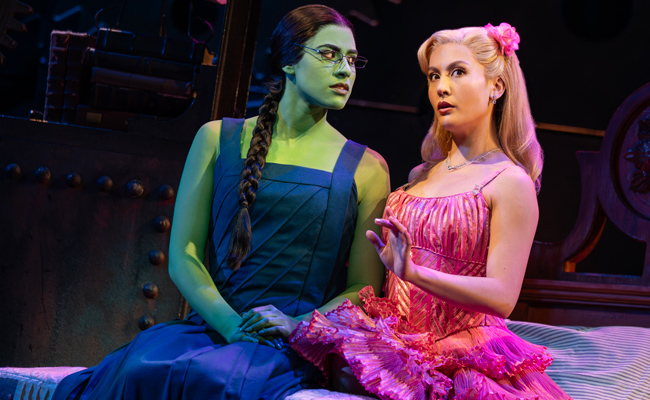
With the staging playing a big part in the enjoyment of the show, it still wouldn’t get far without its two leading ladies, and this tour has really knocked it out of the park with the casting of Galinda/Glinda and Elphaba. Zoe Jensen perfectly captures the bubbly (no pun intended), self-centered attitude of Glinda, her voice sounding remarkably like OG Glinda, Kristin Chenoweth. She gets laughs with the signature hair shake and hair toss and she has terrific chemistry with her co-star. Glinda could easily be an unsympathetic character, especially as it seems that she’s turned her back on Elphaba and joined the Wizard’s ranks. Jensen does a wonderful job of making Glinda both absurd and conflicted as she learns that the world does not revolve around her and she may just have to join the resistance to protect her friend. Jessie Davidson has the showier role of Elphaba. This is her story, after all, and she is fantastic with a powerful voice that soars as high as she does in ‘Defying Gravity’. Davidson can handle Elphaba’s droll reactions to things, but she is also strong. She can make Elphaba a sympathetic character, but not to the point that we feel sorry for her or see her as a victim … even with some of her self-deprecating comments. She is a crusader working for the benefit of those the Wizard (and Madame Morrible) consider the ‘other’, namely the talking animals, seeing how they are being mistreated and ostracized as she has, made into object of fear because they are different. Elphaba is a great character, and Davidson gives a fantastic performance. Together, Jensen and Davidson are a real dream team who help the show soar with humor and deep emotion. And keep a hanky handy for their final duet, ‘For Good’.
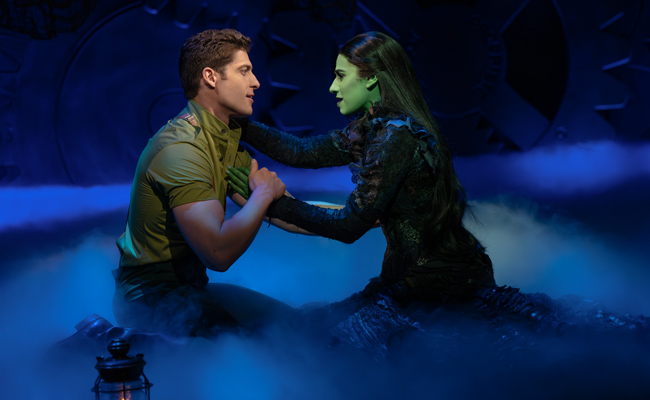
Ethan Kirschbaum is also wonderful as Fiyero, the man who seems to be the perfect match for Glinda, shallow and self-centered — and proudly so — but he is changed by Elphaba, causing Glinda concern when he actually begins to … think. Kirschbaum shows Fiyero’s growth over the course of the story, juggling his comic moments with those more serious with great skill. He also has a nice voice, taking center stage with ‘Dancing Through Life’ and harmonizing wonderfully with Davidson on ‘As Long As You’re Mine’. (One humorous aside — when Fiyero first arrives on stage, his costume greatly resembles that of Gaston from Beauty and the Beast. Perhaps they are kindred spirits.) Nicholas Garza really does a nice job with Boq, bringing all of his insecurities to life, and really making it seem like he does have feelings for Nessarose. He does such a good job of making it seem like Boq is a really great guy that it still comes as a bit of a surprise when he actually turns out to be a jerk, perhaps deserving of his fate.
Joan Marcus
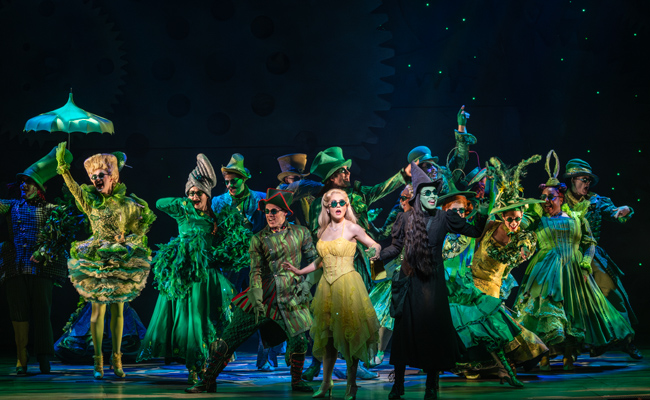
Eileen T’Kaye makes for a wonderfully imposing Madame Morrible, quite snooty but also very diabolical. T’Kaye carries herself in a regal way with a sense of self-importance, but she is clearly trying to climb the ladder to get more power. T’Kaye also has a wonderful voice and really harmonizes well with Davidson on ‘The Wizard and I’, their voices meshing perfectly. Blake Hammond plays The Wizard like a politician who isn’t quite as important as he thinks he is. And that’s what makes him dangerous because he knows he has no power but he will do whatever he needs to get it, and if that means rounding up citizens of Oz he doesn’t like, or calling out anyone who opposes him an enemy of the state … so be it. But when he’s cornered, Hammond can also make The Wizard very humble, quite aware that the walls are closing in and he needs to make some deals and beat a hasty retreat. He may not be quite as sinister as Jeff Goldblum’s Wizard in the movies, but Hammond still makes his Wizard someone you don’t want to turn your back on. Jada Temple gives a really good performance as Nessarose, Elphaba’s sister. Being confined to a wheelchair for the whole first act limits what she can do on stage, but Temple manages to build the character, fleshing her out through facial expressions and body language. When she gets to ‘dance’ with Boq, you feel her joy. And then in Act II, she is a more dour and hardened character, having basically enslaved the Munchkins (including Boq) so she wouldn’t be alone. But when her sister returns, her whole life is turned upside-down and she is made an unwitting pawn in The Wizard’s game to find and trap Elphaba. She is a character who goes through a lot in her life, and Temple does a great job of portraying all of her emotions. Drew McVety is terrific as Doctor Dillamond, the last animal professor at the university. He’s imposing while leading the class, but he becomes more ‘human’ as his connection with Elphaba grows. In Act II though, McVety breaks our hearts as Dillamond is reduced to a bleating, confused goat who has lost his ability to think and talk. It’s a character that could be ridiculous, but McVety does such a nice job that it’s easy to relate to his plight. The large ensemble all do some spectacular work whether as students, citizens of Oz, munchkins, or flying monkeys. They are all there to give one hundred percent in whatever the scene calls for.
All in all, if you’re a fan of Wicked, there is absolutely nothing to complain about with this production. If you’re new to the show, or only know the book or the movies, it is well worth seeing just to get a different take on the material. The production is gorgeous, the cast is brilliant, and the leading ladies are simply magnificent. This is a show you don’t want to miss.
Wicked runs about 2 hours and 45 minutes with one intermission. Recommended for ages 8 and up. Recommended age for children is 8 and up. No children under 5 admitted.
Wicked runs through January 11 at Baltimore’s Hippodrome Theatre. Other cities on the tour include Pittsburgh, Providence, Dallas, Minneapolis and more. Visit the official Wicked website for more information. Use our Ticketmaster link to purchase tickets.
Wicked National Tour

Universal Stage Productions
Check our Ticketmaster link for ticket availability.