
Sony Pictures Classics
Scarlett Johansson’s Eleanor the Great is a film that feels tailor-made for parents and grandparents — a simple, warm, and familiar story that brushes up against heavier themes but never fully plunges into them. In her directorial debut, Johansson assembles a story about grief, loneliness, and moral compromise, anchored by an affecting lead performance from June Squibb. It’s a film that resonates more as a gentle parable than a hard-hitting character study, which makes it an easy recommendation for older audiences but may leave others wanting more.
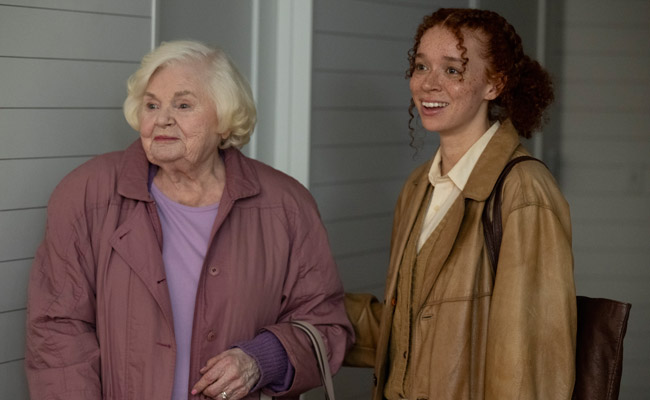
Squibb plays Eleanor, an aging woman who lives with her closest friend — a Holocaust survivor — until that friend passes away, leaving Eleanor alone. Faced with the sudden void of companionship, she moves in with her mother in New York City. There, she tentatively steps into new spaces: joining an orchestral choir, mingling with strangers, and eventually crossing paths with a support group for Holocaust survivors. When someone assumes she is a survivor herself, Eleanor chooses not to correct them. Instead, she begins recounting her deceased friend’s stories as her own, slipping into a false identity born not out of malice but desperation for connection and relevance.
This deception becomes the axis on which the film turns. Eleanor befriends a young Jewish journalist (played with warmth and vulnerability by Erin Kellyman), who is working on a story about the support group. Their bond — forged over shared grief and trauma — is where the movie is at its most affecting. Both characters are, in different ways, adrift: Eleanor in the wake of losing her lifelong companion, and the journalist after the early death of her own mother. Their scenes together allow Johansson’s camera to slow down and give Squibb space to shine, particularly in a series of close-up shots that emphasize her character’s conflicting emotions — guilt, longing, and a fragile sense of self-worth.
Adding another layer to the narrative is Chiwetel Ejiofor, who plays a beloved news anchor Eleanor and her friend once idolized. When he learns that Eleanor is not the survivor she claims to be — a discovery made more complicated by the fact that his daughter is the journalist she’s befriended — the film edges into moral-drama territory. Rather than turning Eleanor into a villain, Eleanor the Great frames her deception as a misguided attempt at self-preservation, using her friend’s memories to fill her own emotional void. This central moral tension — between truth and survival, deception and connection — is the film’s strongest element.
However, Johansson’s direction is at times too restrained for the weight of the material. Her use of intimate close-ups effectively highlights Squibb’s performance, but the film’s visual style overall feels safe, rarely taking risks or deepening its themes through its camera work. There’s a sense that Eleanor the Great wants to be both a gentle, comforting watch and a morally complex drama, but it mostly stays on the surface of its potentially thorny ideas.
June Squibb, though, is a revelation. She brings layers to Eleanor that the script doesn’t always fully explore, showing how loneliness and invisibility can push someone into morally gray decisions. Her performance is the reason the film works at all, elevating what might have been a flat character into someone painfully human and relatable.
Ultimately, Eleanor the Great is a tender film with a unique premise — an older woman risking her reputation and morality for a fleeting sense of connection. But it’s also a film that never fully capitalizes on that premise. The themes of grief, identity, and belonging are all there, but they’re handled with such gentleness that they lose some of their impact. This is a comfortable, quiet watch — the kind of movie you could easily show to your parents or grandparents — but aside from Squibb’s performance, not much about it lingers once the credits roll.
Eleanor the Great has a run time of 1 hour 38 minutes, and is rated PG-13 for thematic elements, some language and suggestive references.
Sony Pictures Classics