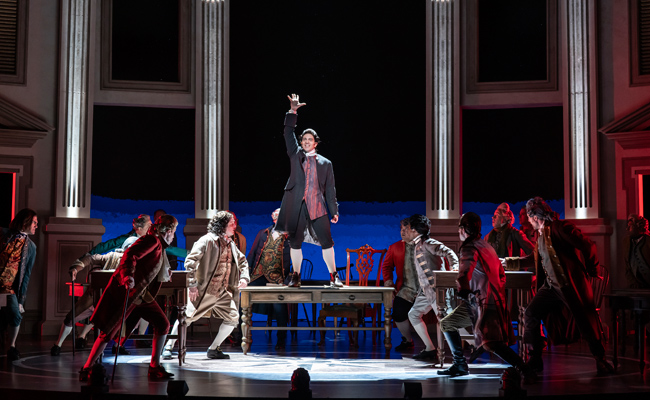
Jonathan Atkinson as John Adams
and the cast of the 2026 Ford’s Theatre production of 1776.
Photo by Scott Suchman
1776 is directed and choreographed by Luis Salgado and with music direction by Clay Ostwald. Photos by Scott Suchman. The production plays March 13 – May 16, 2026, and features Scenic Design by Milagros Ponce de León; Costume Design by Ivania Stack; Lighting Design by Venus Gulbranson; Sound Design by David Budries; Projection Design by Clint Allen; Wig and Make-Up Design by Kelley Jordan. All photos provided by Ford’s Theatre.
With the United States of America on the verge of celebrating its 250th anniversary on July 4th, it’s only fitting that the Tony Award winning Best Musical of 1969, 1776, is seeing the light of day on the stage again. And what better place to breathe new life into the show but by the company at Ford’s Theatre in Washington DC? (Okay, some may say Philadelphia is more appropriate since that’s where the show is set, but Ford’s is still a piece of living American history.) The show was revived on Broadway in 2022 (and toured) with a novel approach to the casting with a female/trans/non-binary cast, but Ford’s goes a more traditional route while also observing the theatre’s tradition of color-blind casting. So what is 1776 about?
The show itself is about the months and days leading up to July 4, 1776 and the signing of the Declaration of Independence, removing the American colonies from England’s rule. Beginning on May 8 with the convening of the Second Continental Congress at Independence Hall in Philadelphia, John Adams is frustrated at the roadblocks he experiences in advancing his proposal for independence. Adams is known among the members of Congress as stubborn and unlikable, so his good friend Benjamin Franklin suggests the only way to advance his proposal is to get someone else to do it, namely the egotistical but genial gentleman from Virginia, Richard Henry Lee, whom Franklin actually convinces the idea is Lee’s own. A new delegate from Georgia arrives a few weeks later with no clear guidance on how to vote for the measure except to use his own discretion, but he seems to be slightly bullied into following the lead of South Carolina’s Edward Rutledge, to whom North Carolina’s Joseph Hewes already defers to. The Carolinas stick together, and Rutledge expects Georgia to join them. The proposal’s biggest detractor is John Dickinson of Pennsylvania, who has no problem remaining a colony of England or paying the king’s exorbitant taxes. He bristles any time Adams refers to the king as a tyrant. Dickinson is accompanied by a second delegate from the state, James Wilson, a judge whom Dickinson rarely allows to get a word in edgewise and expects that he too will vote as he does. After Lee presents the proposal for independence, which everyone knows is actually coming from Adams, they are split six-six on a vote with New York abstaining (New York abstains on every vote, and it’s not until later in the show when Lewis Morris finally reveals why), president John Hancock casting the tie-breaking vote to move forward. Once confirmed, Adams now needs someone to write the declaration because he and Franklin know that no one will vote on it if it comes from Adams. Adams can think of no one more qualified, a better writer than even himself, than Thomas Jefferson. Jefferson, however, has already made plans to return home to his wife Martha after being gone for six months. Adams misses his wife Abigail in Boston as well, but they have to get this done now or it will never happen. Jefferson is backed into a corner but can’t come up with a single thought, so Adams calls for Martha and once she arrives and the couple gets some alone time, Jefferson’s writer’s block is released and the document is forged.
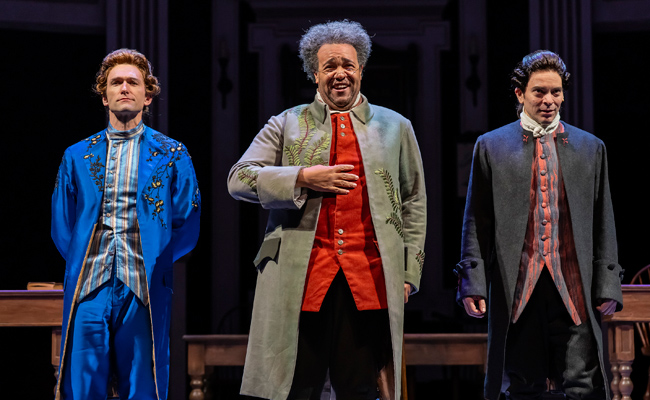
Jake Loewenthal as Thomas Jefferson,
Derrick D. Truby Jr. as Benjamin Franklin
and Jonathan Atkinson as John Adams
in the 2026 Ford’s Theatre production of 1776.
Photo by Scott Suchman
But there are issues among each and every member of Congress, from single words or phrases to an entire paragraph, specifically on the topic of slavery. Rutledge in particular is adamant that the South will not vote for independence unless the issue of freeing slaves is removed from the document, and some of their friends from the North are also on board. Rutledge goes so far as to point out some of the hypocrisy of the Northern members who profit from shipping the slaves to the South even if they don’t own slaves themselves. Adam and Jefferson refuse to budge at first (and in the show Jefferson states that he is in the process of freeing his slaves, which did not happen historically until after his death), but Franklin convinces them that independence is on the table and slavery can be addressed at another time. They finally and reluctantly agree, but when it comes time to vote Dickinson again throws up another roadblock and insists any vote for independence must be unanimous. As the days tick closer to July 4, and dispatches from General George Washington paint a bleak picture of his dwindling troops while thousands more arrive from England, it takes some surprising demonstrations of courage to (spoiler alert) finally get the proposal approved.
Ford’s Theatre’s production of 1776 is really quite spectacular. I am not all that familiar with the show, having only seen a few snippets of the motion picture adaptation (and seeing how it figured into the plot of Season 3 of Grace & Frankie), so I have a feeling that most people in the audience will not have seen a production of the show before. With the America 250 celebration ramping up to July 4, this would certainly be the best opportunity to familiarize yourself with it. Ford’s takes a novel approach to get into the show proper with a short prologue that stages an America 250 interactive exhibit on stage, and what appears to be random people walking onto the stage and looking at the exhibits. (Don’t attempt to join them!) As a tour guide begins his presentation and explains the type of magic that can happen while examining these historical artifacts, one gentleman taps a cane on the floor, transforming the backdrop and lighting, releasing the spirits of the men (and women) from the era, bringing the show to life. It’s a very cool way to get into the show and acknowledge the anniversary of independence, and you almost don’t realize that some of the visitors to the museum are transformed into the characters of the show. It’s all staged and choreographed so well by director Luis Salgado that you barely notice the transitions and you are immediately transported back to 1776. With a static set, Salgado expertly uses a massive video screen to depict the world beyond the columns of the hall — beautifully created and rendered by Scenic Designer Milagros Ponce de León and Projection Designer Clint Allen — working hand in hand with the stunning Lighting Design by Venus Gulbranson, accentuating the entire stage during group scenes, and becoming more intimate and focused when necessary. The show is just a visual masterpiece, also aided by David Budries’ Sound Design. I can’t speak to how historically accurate Ivania Stack’s Costume Designs are, but this is a musical and the costumes are beautiful, my favorite being Lee’s colorful jacket. Kelley Jordan’s Wig and Make-Up Design also delivers on what we would expect from politicians of the era, and all the wigs are perfection (although I do question why Franklin is seen bald on the poster artwork, but he has a wig in the show). I also have to give credit to Dialects and Voice Director Rachel Hirshorn-Johnston as several of the actors do speak with specific accents (Scottish is one in particular), and if these are not native to the actors, Hirshorn-Johnston and the actors have done a magnificent job of making them sound natural. Also the eight-piece band, led by Clay Ostwald, sounds every bit as amazing as a full orchestra, beautifully delivering every note of the score. Every technical aspect of this production is top notch and could rival the best Broadway production.
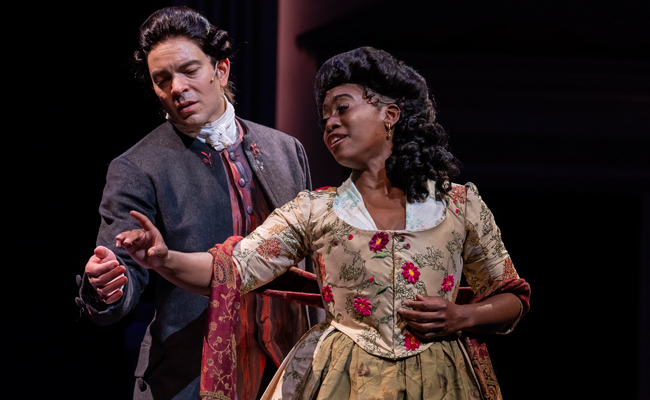
Jonathan Atkinson as John Adams
and Kanysha Williams as Abigail Adams
in the 2026 Ford’s Theatre production of 1776.
Photo by Scott Suchman
And while the technical parts of the show are spectacular, it is all matched by the outstanding casting. Right off the bat, Jonathan Atkinson grabs you by the collar and draws you into the world of 1776 with his magnetic performance as John Adams. He is the central figure of the story, and Atkinson’s performance is really beyond words. He captures every emotion of Adams, his determination, his frustration, his comradeship with Franklin and Jefferson, his deep love for his wife Abigail, and most importantly, his love of his country. And when he opens his mouth to sing, he commands your attention. Once Atkinson grabs you, he never lets you go and the show greatly benefits from his performance. Everyone else is also fantastic, but they have to be on their toes to match the energy of Atkinson. Derrick D. Truby Jr. is also wonderful as Benjamin Franklin, sort of the comic relief of the story, known for his clever sayings, randy reputation with the ladies, and dozing off during meetings. But he is the one who keeps the hot-headed Adams focused and on track, guiding him subtly on how to approach the members of Congress to get them on his side. Truby brings out Franklin’s wry sense of humor, but he also knows when to put his foot down to get others to listen. He may be the comic relief but he is also the wisest man of the group, the one they are most apt to listen to, and Truby walks that fine line with great skill. The third member of the trio is Jake Loewenthal as Thomas Jefferson, the reluctant author of the declaration. He clearly does not want the task thrust on him but his attitude clearly lightens after his wife arrives. Jefferson may, perhaps, give in a little too easily to some of the demands for changes to his work, but he also has to be firm with Adams or else they face a stalemate on the vote (he does get one humorous moment of objection to a change). Loewenthal also has a wonderful voice, and when he, Truby and Atkinson sing together, it is magical.
There are many, many people in this cast and I don’t want to short any of them. Each and every member of this cast not mentioned in the review — Thomas Adrian Simpson, Keith Richards, Stephen F. Schmidt, Jimmy Mavrikes, Christopher Mueller, Greg Twomey, Buzz Mauro, Steve Lebens, Peter Boyer, Lawrence Redmond, Ricky DeVon Hall — is nothing short of fantastic even if they have the smaller or less-showy roles. They all have their moments, and when they all sing together in the group numbers, their harmonizing is wonderful. I must also point out that for our performance, several actors took on different roles — Wood Van Meter and Douglas Ullman Jr., with understudies Brendan Schaefer and Ian Charles filling in for two other roles — without missing a beat. Van Meter in particular transitioned from his usual, smaller role of Samuel Chase (Maryland) to the role of Dickinson, with almost as much stage time as Atkinson. It boggles my mind that an actor can completely memorize one role, much less two, and if I hadn’t seen the announcement in the program I would have never known the role of Dickinson was not his main role. The blocking, the performance, the songs, all of it done to perfection, Van Meter completely commanding the stage, delivering his magnificent vocals for Dickinson’s numbers, really giving him that moment to shine. I’m sure Evan Casey is just as spectacular in the role, but it was a privilege to see Van Meter on stage again after having seen his performance years ago at Toby’s Dinner Theatre in the lead role of Joseph and the Amazing Technicolor Dreamcoat. Also doing some fantastic work is Michael Perrie Jr. as Richard Henry Lee, a man so full of himself that almost every word has to end with ‘Lee’. He is a bit of a clown, intentional-lee, but his performance lightens up some of the more dramatic moments. Joe Mallon is also very good as Edward Rutledge of South Carolina, a bit imperious and overbearing, knowing he holds the decisions made by North Carolina and (he assumes) Georgia in the palm of his hand. Tom Story also brings some nicely conflicted emotions to Dr. Lyman Hall of Georgia, tasked with following his heart on any decision but feeling pressured by Rutledge to follow his lead.
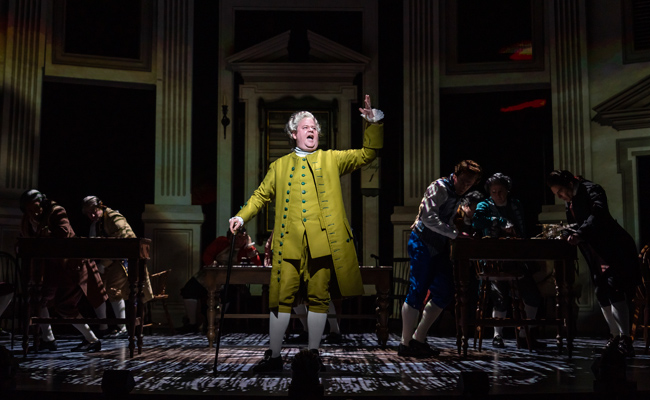
Joe Mallon as Edward Rutledge
and the cast of the 2026 Ford’s Theatre production of 1776.
Photo by Scott Suchman
John Floyd gives a lovely performance as Charles Thomson, the Congressional Secretary, tasked with calling for votes and, most importantly, reading the increasingly dire dispatches from General Washington, treating each one as if Washington was writing to him personally. Jay Frisby is also wonderful as Dickinson’s compatriot from Pennsylvania, James Wilson. His Wilson is quite meek at first, constantly allowing Dickinson to talk over him and assume their opinions are one and the same, but he has to come out of his shell in Act II and decide his place in history — does he want to be remembered as the man who voted against independence, or simply not remembered at all as just another signature on the document? His final declaration to Dickinson is one of those ‘stand up and cheer’ moments. Hunter Ringsmith makes occasional appearances as the courier delivering the dispatches from Washington, a small, nearly silent role, but he gets a beautiful moment to shine in Act II when asked by the Congressional Custodian (Lawrence Redmond) and Leather Apron (Ricky DeVon Hall) what it’s like out there, and Ringsmith delivers a haunting song about seeing his friends die in front of him and mothers coming to search for their sons who have not returned home for dinner. It is a moment that grabs your heart, the emotion of the performance bringing the room to complete silence, Ringsmith looking totally haunted by the end. Just terrific.
While the cast is predominant-lee male, there are two notable women on stage. Kanysha Williams appears as Abigail Adams, bringing warmth and intelligence to the role, not one to put up with being a second-class citizen with her husband, really putting that on display in a back-and-forth moment about saltpeter and pins, delivering her songs with a lovely, operatic voice, and clearly showing the love she has for her husband. Justine ‘Icy’ Moral is also wonderful as Martha Jefferson, particularly in the moment she meets Adams and Frankin, unaware that she had met them the night before (she was only focused on Thomas in that moment), and sings to them about Jefferson’s violin playing and how the two of them would dance. Moral really makes this a moment all about love and it also serves to humanize Thomas a bit more. She really makes the moment heartwarming and delightful.
Now, is 1776 historically accurate? Yes and no. As Congress met in secret back in those days, there really are no records of things that were said, most of it coming years later either from those who were there or from second-hand accounts. There were more people in that room where it happened than depicted in the show, and even the character of Adams is a conglomeration of several people (also, historically, Adams was not disliked at all — that came from his own recollections after his presidency — and it was Franklin he disliked). Historians also disagree about the actual date of the signing of the Declaration of Independence, but history has long cemented it as July 4. There are anachronisms in the show as well, but there are also many historical facts that may be new to you about the founding of the country (such as Maryland being one of the states against independence). 1776 is a history lesson delivered through the lens of entertainment, expertly written by Peter Stone, with music and lyrics by Sherman Edwards, that make the story anything but dry and boring. Ford’s Theatre’s director, crew and amazing cast of actors bring history vivid-lee to life, showing us how our forefathers fought so hard against tyranny (with some embracing it — some things never change apparently), something extremely important to remember today as we see those efforts 250 years ago starting to fall apart before our eyes. 1776 is an important show, especially now, and we all have to fight to make sure it remains a show to be celebrated and revived, not a story relegated to the dustbin of history.
1776 runs about 2 hours 30 minutes with one 15 minute intermission. Recommended for ages 12 and up.
1776 runs through May 16, 2026 at Ford’s Theatre in Washington DC. The next production will be Come From Away, on stage from September 10 to October 18, 2026.