Matthew Murphy and Evan Zimmerman
F. Scott Fitzgerald knew Baltimore well. He lived here for many years, all throughout the city, writing and drinking and writing and drinking. They were largely unhappy times in his life, trying to revitalize his career after not selling a novel since the book that would become known as his magnum opus. His wife, Zelda, was in and out of the hospital as she battled her own mental health. And did I mention he was drinking? A lot. He once got so drunk at the Stafford Hotel (the Stafford is now an apartment building, home to the first Baltimore apartment lived in by the young writer whose work you are currently reading), his tab rang up at $22.36 — nearly $500 in today’s dollars.
Now, some 90 years later, Fitzgerald returns to Baltimore, in spirit alone, through his most synonymous work — The Great Gatsby, whose North American Tour launches at the historic Hippodrome Theatre at the France-Merrick Performing Arts Center this week.
When one reviews a tour of a Broadway production, there is a push and pull inherent in that work: do I review the material or the production? Some answers are more obvious than others. When The Lion King comes to town, there is absolutely nothing new I could say about the music, lyrics, story, puppets, anything — I am instead inclined to talk about that performance on that night and nothing else. When a show is still relatively new — as this adaptation is — there’s some assumption that the reader is not familiar with the text, with the often unlikely exception of those who caught it in New York or London, or the even more unlikely Seoul.
The Great Gatsby, this particular stage adaptation with music by Jason Howland, lyrics by Nathan Tysen, and a book by Kait Kerrigan, is in an odd in-between. The show opened on Broadway just under two years ago, but, you know, it’s The Great Gatsby. It’s the book you read in your freshman year English class. It’s the movies with Redford and DiCaprio. It’s the word slapped onto so many parties with a terrible Roaring ‘20s theme. Since the copyright expired in 2021 and the novel entered the public domain, it’s been completely unavoidable as everyone’s lunged for the recognizable title. This musical is one of two that popped up around the same time, beating the other to Broadway, and causing its audience members to clog up my favorite dollar pizza place in Manhattan, the one around the corner from the theatre.
The point is: I feel comfortable spoiling the details of The Great Gatsby. If you’ve managed to get this far in your life without the book, you should read it. It is, obviously, very good.

Matthew Murphy and Evan Zimmerman
Nick Carraway, a veteran of the Great War (and the story’s narrator), has moved to New York in hopes of finding work in bonds. The modest cottage he rents on Long Island is on the property of one Jay Gatsby, who throws lavish, expensive, notorious, gossiped-about parties, a man so elusive no one quite knows anything about him. Nick’s cousin, Daisy, lives across the way with her peaked-at-Yale husband, Tom. When Nick does finally get invited to one of Gatsby’s great soirees, he learns that it’s because of his connection to his cousin — Gatsby fell in love with Daisy before he too shipped off to war, and he’s hoping to use Nick, and his newfound piles of money, to convince her that she’s married the wrong man.
I must say, The Great Gatsby is my favorite book. That’s a boring answer to the question asked of so many English teachers and culture critics, but it is my truth. I consider it to be the leading contender for the Great American Novel. It’s the novel I’ve re-read the most in my life. I’m a staunch defender of the far-too-maligned Baz Luhrmann adaptation for the screen. Hell, I’m so committed that I paid an exorbitant amount of money to see the Elevator Repair Service production of Gatz, their word-for-word reading of the book that lasted eight hours and included a dinner break. If that doesn’t supply me with Gatsby credentials, I don’t know what does.
I also believe that makes me the wrong person to review this particular adaptation of The Great Gatsby, one that paints the story’s scenes with the broadest of strokes, and one that seems only interested in its most surface-level themes. Fitzgerald’s novel is a critique of the rich, what with their ridiculous parties and irresponsible attitudes towards those objects (cash, luxuries, people) that they find disposable. Fitzgerald saw the delicate balance between how these people got their money and what they would do to keep it — he forecasted the impending stock market crash and Depression from a mile away — to be symbolic of how empty and hollow these people are (still are) on the inside. Tom spews some really vile racist comments early in the novel (which are completely missing in this relatively PG production), and beats up on his mistress, Myrtle, the wife of a lowly gas station attendant, George. Gatsby’s facade is just that, an illusion of status and control, cloaking the scared little boy who turns out to be a total loser (it’s one hell of a coincidence that DiCaprio played both Gatsby and The Wolf of Wall Street’s Jordan Belfort, two practically identical characters, in 2013) by the book’s end. Even the book’s ancillary characters are dangerous bootleggers and the guy who fixed the 1919 World Series. That’s why your Gatsby parties are dumb. These are not people we want to be; these are the people we should be afraid of.
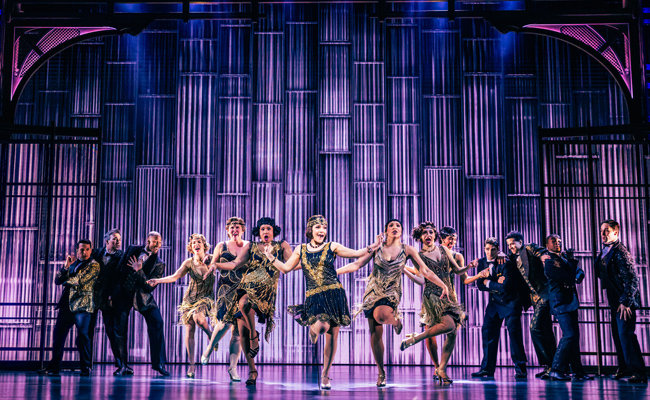
Meanwhile, the cast of the musical literally sings a song about how great it is to have money while sparklers illuminate the stage. And it’s probably the best part of the show.
That’s not to say that Howland, Tysen, and Kerrigan’s piece, or director Marc Bruni’s staging, misunderstand Fitzgerald’s seminal work. They are no doubt intelligent people and thoughtful creatives. I just don’t think that they care. They just want to throw a big party, and they request the pleasure of our company.

Matthew Murphy and Evan Zimmerman
I find this curious, considering that most of the songs are drab ballads where characters recite exposition or monologue their feelings. There’s a stretch in Act I where five different characters each get their own song — Gatsby, George, Myrtle (this is listed as a group number, but it’s Myrtle’s song), Daisy, and Nick — to pour out their feelings and make complete nonsense of Nick’s role as the narrator. Everyone was up in arms when the Luhrmann film dared to use hip-hop, songs by Beyoncé and Jay-Z, on its soundtrack, but at least that aspired to something thematically. Almost every song in this musical has a dreary feeling of sameness (there’s a reason that the 16 bars of the aforementioned ‘New Money’ went viral on TikTok — it’s the only thing worth singing later), with lyrics like ‘Butter me, honey, tonight I’m on a roll,’ ‘If I wondered whether Tom’s an asshole, Tom’s an asshole,’ and, I wish I was making this last one up, ‘I’m gonna walk into the ocean.’ At least they managed to have two people singing at the same time in that one. Compare that to any random bit of Fitzgerald’s prose (Take ‘Angry, and half in love with her, and tremendously sorry, I turned away,’ for example) and you wonder why, considering the novel’s public domain status, they didn’t just steal from the best.
The cast does their best with the material, even though it does often lack nuance. Jake David Smith, as the titular character, excellently sings his way through the piece, although Gatsby’s newfound neuroses might tip his hand a bit early. Joshua Grosso understands his role as the story’s narrator, even if it’s frequently taken away from him. Will Branner looks the part of the polo-playing Tom, and plays up his ‘brutish’ behavior as the show tries to gloss over most of it. The highlight is Senzel Ahmady, fresh from the Korean production, as Daisy. A gorgeous singer, her character is beautifully imbued with tenderness and fragility. It helps, naturally, that her depiction remains faithful.
This is more than The Great Gatsby in-name-only, but no more than the story in-plot-only. With all of the subtlety wiped clean, what we are left with is only its most vivid images: dancing the Charleston and sequin dresses and lavish parties and a rich man’s Rolls Royce (okay, fine, it is kind of cool when they drive the car around the stage) and martinis and, of course, the green light. It’s for people who like their Planet of the Apes with Mark Wahlberg and their Total Recall with Colin Farrell and their steak, I can only assume, no less than well done. Gone is all of that mucky morality stuff that drove Fitzgerald to write the novel in the first place. Booooring! Let’s party, dance, and, as Fitzgerald (unfortunately) did so well, have a drink. This is not the Roaring 2020s we were promised after all, what with that global pandemic and the fascist regime and the death of journalism and all that. Who needs subtlety these days?
The Great Gatsby runs about 2 hours and 30 minutes with one intermission. Recommended for ages 10 and up. Infants are not allowed in the theater. Children 5 years of age and above are permitted but must have their own ticket.
The Great Gatsby runs through February 7 at Baltimore’s Hippodrome Theatre. Other cities on the tour include Louisville, Dallas, Kansas City, New Orleans, Chicago, Washington DC, Pittsburgh, Minneapolis, Boston, Toronto and more. Visit the official website for more information. Use our Ticketmaster link to purchase tickets.
The Great Gatsby – North American Tour

The Great Gatsby Musical
Check our Ticketmaster link for ticket availability.

I went to the Sunday matinee of this show and we saw many folks leave during intermission due to the, for lack of a better word, boring nature of this production. Saying that the 16 bars of New Money was the only think worth repeating later is right! Your take is a great review of this show.