Hotchka
Baltimore’s Iron Crow Theatre, the city’s only queer theatre company, returns to the M&T Bank Exchange, a space housed inside the Hippodrome Theatre, with a new production of the groundbreaking, Tony Award winning Broadway musical, Next to Normal, a show that may be difficult for many to sit through as it tackles some very tough subject matter, but by the end as the characters — and audience — come through the story, there is a glimmer of hopefulness.
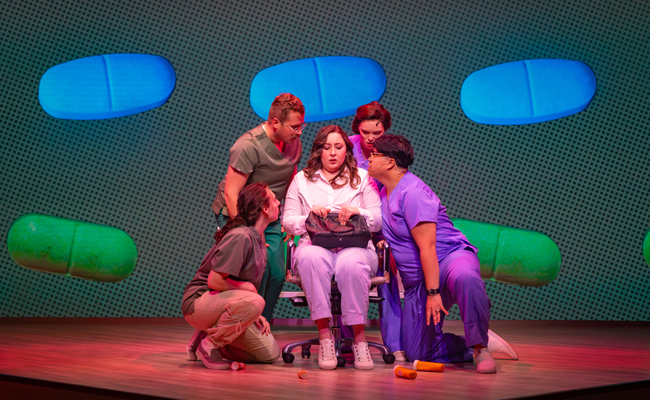
Next to Normal, written by Brian Yorkey, with lyrics by Yorkey and music by Tom Kitt, centers around a family consisting of mom Diana, dad Dan, daughter Natalie and a son, who goes unnamed until the very end of the show. As first presented, the family appears normal, if dysfunctional, with Diana describing each member in the song ‘Just Another Day’. It’s clear she dotes on her son, has issues with her daughter, and has even more issues with her husband. It suddenly becomes clear, however, that Diana is the one with issues when she has a bit of a breakdown and starts making sandwiches … on the kitchen floor. Dan calmly, but hurriedly, gets Diana to the doctor while Natalie goes to school to practice for her upcoming piano recital. While practicing, she meets Henry — whom she’s actually known for years but never really paid him any mind — and the two hit it off. Meanwhile, Diana is telling the doctor that the myriad number of medications she’s on are not working anymore, and when she says she just feels numb he declares her ‘stable’. At home, Diana is remembering the emotions she used to have, and at the urging of her son, she dumps all of her pills down the drain. Things progress between Natalie and Henry, and he is accidentally invited to dinner — Natalie is not ready for him to meet her family, but Dan catches him at the door and tells him to join them — and Diana brings out a birthday cake to celebrate her son’s 18th birthday, but the party does not go as planned. Diana reveals she stopped taking her meds and tells Dan he can never understand her pain, even though Dan has been making the effort to try to understand what she’s going through.
Wilson Freeman
Dan finds a new doctor for Diana, and after going down the list of medication she’s been taking, he suggests they try to start to get at the root of her issues with talk therapy. With memories and visions overtaking her, Diana consents to trying hypnotherapy which allows her to open up about her relationship with her son, her strained relationship with her daughter, and the empty feeling she has for Dan. While Diana is in therapy, she and Dan miss Natalie’s recital, which causes her to screw it up, and Dr. Madden encourages Diana to begin getting rid of the things in the past that keep haunting her. She tries, but the visions are too overwhelming … and Diana attempts suicide. Having taken this drastic step, Dr. Madden suggests ECT (electroconvulsive therapy, aka shock treatment), which may come with some side effects like memory loss, and Dan has to convince Diana to go through with it so they can have a chance to get back to normal. But the treatment causes major memory loss, including not remembering her children, but Diana still feels there is something missing despite Dan’s attempts to help her find those memories Dr. Madden assures are hidden in her brain … to the point that Dan takes the opportunity to fudge some of the details to make the ‘memories’ maybe happier than they were (and Natalie wastes no time in calling out his shenanigans). At her next visit with Dr. Madden realizes Dan has not been honest with Diana and he urges her to talk with him. Diana goes home and finds something that feels familiar yet unfamiliar, and Dan is forced confront her with the truth about their family, which nearly causes her to have another psychotic breakdown. Dan insists she needs more ECT treatments and promises he is committed to her, but Diana tells Dr. Madden that she is done with the treatments and her visits with him. During this time, Natalie begins to struggle with substance use after finding some of her mother’s pills, and Henry grows concerned, feeling that trying to get her out of her home environment by inviting her to the school dance will give them a chance to connect further despite her refusal to say yes to his offer. It comes down to a real heart-to-heart between Diana and Natalie where they note their similarities that leads them both to make important decisions that will be life-changing for all of them … but this may be the only way they can all survive and rebuild their lives as something next to normal.
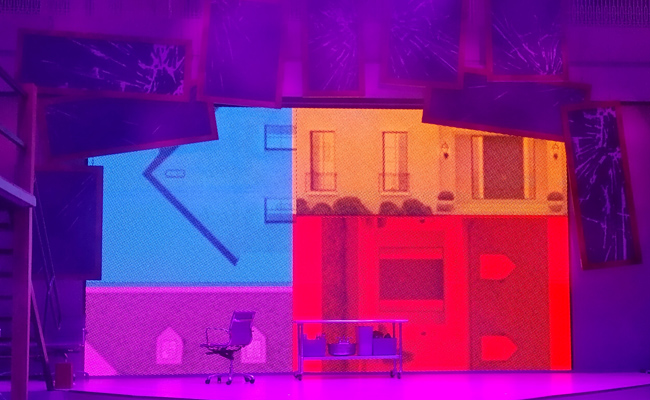
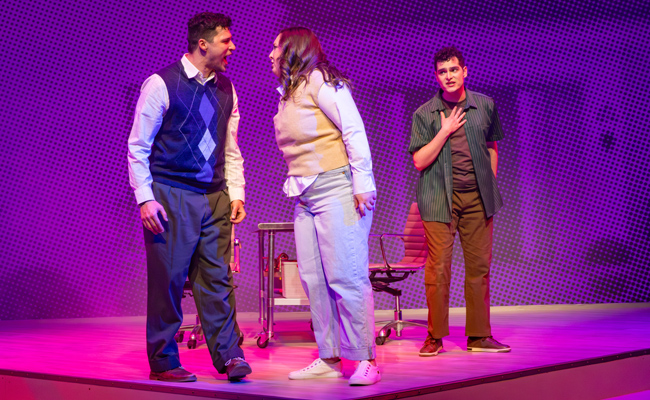
This production of Next to Normal was constructed and staged specifically for the space of the M&T Bank Exchange — the third collaboration between the two organizations — and director Natka Bianchini has done a magnificent job of using the unique space to her advantage, with a large stage, an elevated space, a large video screen background, and the orchestra visible to the audience’s right (or stage left as it were). The seating for the space also includes ‘bleacher’ type seats, and Bianchini uses the stairways on both sides as part of her staging. While this is a musical, there is no dancing, but Bianchini has choreographed the movements of the actors and minimal setpieces (a table and chairs) to keep the show flowing smoothly without being flashy and detracting from the story. The projections, by Chris Carcione, are used throughout the show, mainly with an image of the family’s house exterior in various formations, but there are also some visual ‘memories’ that Diana is experiencing including those of being in the mountains. Thomas P. Gardner’s lighting design also adds to the storytelling, directing the audience’s vision from one point on the stage to another, or spotlighting a specific character for emphasis. It all works together to deliver the emotions of the story, drawing the audience in deeper and deeper.
Wilson Freeman
The cast is also spectacular. As Diana is really the focal point of the story, a powerful actor is required for the role and Allison Bradbury checks off all the boxes that bring Diana to life. She totally throws us off at the start, seeming like a completely average wife and mother who likes to playfully trash talk her kids and views sex with her husband as a chore. When she has her breakdown with the sandwiches, Bradbury manages to remain almost blank, unaware of what she’s doing, and even as her condition — depression or bipolar disorder — begins to worsen, she keeps Diana in a neutral space, never taking her completely over the top into pure madness but still being able to convey how completely delusional she is. Bradbury also has a powerful voice and she packs every ounce of emotion she can into Diana’s songs. Her performance allows the audience to invest in Diana’s attempts at recovery, keeping us firmly on her side with the hope that she will find a way to come through the darkness she’s been living in for so long. It is a masterful performance, making this a must-see event.
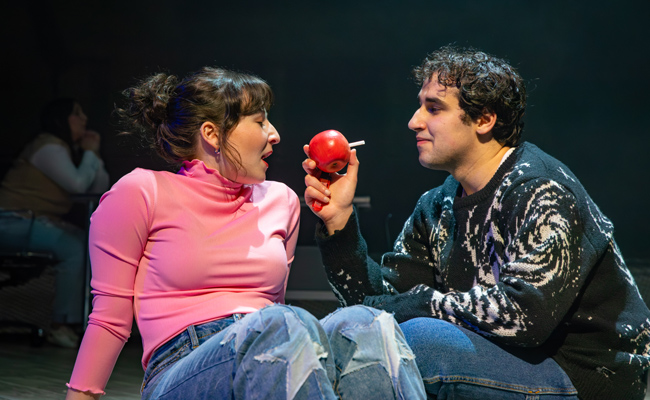
That’s not to say anyone else here is slacking. Danny Bertaux is also terrific as Dan who, despite his own pain, has to be the partner and parent holding the household together. He perhaps may not know how far gone Diana is until the birthday party, but he gives Dan such sincerity when he tells Diana he has stayed with her because he takes their wedding vows seriously, and that he would go to any lengths to help Diana recover and heal. Bertaux makes Dan the rock of the family, and in the final scenes of the show he is finally able to crumble a bit and finally admit that he’s been hurting but in denial. Bertaux also has a fantastic voice and pours Dan’s emotions into each of his songs. Alexandra Lopez is wonderful as Natalie, at first a typical, somewhat rebellious teen, but after she meets Henry she begins to show all of the layers that there are to Natalie, to the point that she is able to expose to Henry her fear that she may end up like her mother. And when she sings she really raises the roof. Brashley Stein does a great job as Diana’s son, the real linchpin of the story. Stein manages to make the boy both an innocent and a seducer, using his body language to slither around the stage at times, appearing to be a loving son while also seeming to tempt his mother into doing the unthinkable (or is that just Diana’s perception of him?). It’s another fantastic performance. Jason Zuckerman’s Henry is the one ‘normal’ character in the story, and it is adorable how he wants to protect Natalie. He is the stability she needs, if she can just see that and let him be there for her. Pat Collins is also very good as both of Diana’s doctors, the first (Dr. Fine) only interested in keeping her doped up, and the second (Dr. Madden) sincerely wanting to help her deal with her deep-seated emotional issues, doing his best to assure Dan that his methods will help even when it seems they are only doing more harm. The cast is rounded out by an ensemble that includes Heather Nicole Reed, Dani Rizzo, Kelly Mok and Jake Stibbe, portraying various background characters, moving things around the stage, and joining the main cast in song.
Wilson Freeman
I honestly had no real reference going into Next to Normal other than the Season 5 musical episode of Riverdale, which sort of borrowed the musical’s plot for a portion of the show’s storyline while plugging songs into other storylines, so I was not prepared for how emotional the story was going to be or how hard it would hit me. There are parts of this story dealing with trauma that you’re going to feel deep in your soul, but by the end you will see that there is a process to find your way out of that darkness, from that deep sadness you may be carrying with you, just as Diana — and Dan — have carried with them. It is a show about tragedy and living with grief, and living with the grief of others though you may not be experiencing it yourself. It could have been a total downer of a show but Diana manages to find her way, showing us that there is always hope, a light in the darkness. Iron Crow Theatre’s production of Next to Normal has humor and emotion, it can be a gut-punch, but it is ultimately uplifting and should not be missed.
Next to Normal runs about 2 hours and 25 minutes with one 15 minute intermission. This production includes themes of mental illness, grief, trauma, drug use, suicide, and loss, as well as explicit language and sexual content. The production design features loud sound effects, haze, and bright, strobing lighting effects. Viewer discretion is advised.
Next to Normal runs March 6 – 8 and March 13 – 15 at Baltimore’s M&T Bank Exchange at the Hippodrome Theatre. The Season of Survival’s next production is Max Vernon’s The View Upstairs, on stage May 29 – June 14, 2026.
Check our Ticketmaster link for ticket availability.
