
Sidney Sheldon Productions
We’re thick in the middle of the Fall premieres and this week across the decades is loaded with classic — and not-so classic shows, from sitcoms to dramas to steampunk Westerns. 1965 was the biggest year of the week with multiple hit series. 1985 was also a big year this week with several hit shows and one bona fide classic that introduced the world to those girls of gold. With so much to see, we’ll skip all the teases and just let you dive right in. Are any of your favorite shows celebrating milestone anniversaries this week? It seems almost inevitable that there would be!
1955
- September 14 – Hollywood Preview (DuMont, One season, 74 episodes)
- September 14 – MGM Parade (ABC, One season, 34 episodes)
- September 17 – The Perry Como Show (NBC, Four seasons)
- September 18 – Famous Film Festival (ABC, Two seasons, 56 episodes)
- September 20 – Cheyenne (ABC, Seven seasons, 108 episodes)
- September 20 – Joe and Mabel (CBS, One season, last broadcast on September 25, 1956)
- September 20 – Navy Log (CBS/ABC, Three seasons, 104 episodes)
- September 20 – The Phil Silvers Show (CBS, Four seasons, 143 episodes)
- September 20 – Warner Bros. Presents (ABC, One season, 36 episodes)
The format for Hollywood Preview was similar to today’s entertainment news shows like Entertainment Tonight and Extra. Because it was on the DuMont network, no episodes are known to exist. MGM Parade was a promotional series put together by MGM’s trailer department. Famous Film Festival was the first primetime movie series on American television with ABC securing the rights to air 35 British films from the Rank Organisation.
Cheyenne was the first hour-long Western on American television, and the first hour-long drama with continuing characters to last more than one season. It was also the first series from a major Hollywood studio, Warner Bros. The show went on hiatus during the 1958-1959 season when star Clint Walker went on strike for better financial terms, including increased residual payments, a reduction of the 50% cut he had to give the studio for personal appearances, and a release from the company’s restrictive record label contract. The series won a Golden Globe in 1957 for Television Achievement, and was nominated for an Emmy the same year for Editing.
The Phil Silvers Show was originally titled You’ll Never Get Rich. A pilot titled ‘Audition Show’ was never aired. All 143 30-minute episodes were filmed, but the series broadcast a live one-hour episode in 1959. The show is probably better known by its Syndication title, Sergeant Bilko. Most of the episodes were presented as a live performance, with cast memorizing lines and performing scenes in sequence for a studio audience, leading to occasional flubs and awkward pauses. Paul Ford was notorious for forgetting his lines, and when a blank look would come across his face, Silvers and the rest of the cast would improvise to save the scene until Ford would pick up where he left off. Neil Simon joined the show as a writer in Season 4, writing 20 episodes and the series finale. CBS made the mistake of selling the rights to the show to NBC after its cancellation, and NBC reran the show five days a week to great financial returns. Silvers was able to play off of the Bilko persona for the rest of his career. The persona was also ‘borrowed’ by Hanna-Barbera for the cartoon series Top Cat. The show won Best Comedy Series at the Emmys for its first three seasons, and was nominated for the fourth. Silvers was also nominated as Best Actor in a Comedy Series every season, winning for the first. The show earned 17 Emmy nominations total, winning a total of eight (four of the wins came from the five first season nominations).
‘Wheel series’ Warner Bros. Presents was made up of three series: Cheyenne, Casablanca and Kings Row. It was the first series of any kind made by Warner Bros. As movie studios struggled from the competition presented by the emerging television format, Jack L. Warner saw potential for the studio, inspired by Walt Disney’s Disneyland program, believing television could be used to cross-promote upcoming studio films. Originally episodes ran about 45 minutes, with the rest of the program devoted to promoting upcoming Warner Bros. films. ABC saw this as free commercial advertising and exerted pressure on the studio to abolish the segment before the season ended. Only Cheyenne was a success, figuring in the Top 20 if ratings had been calculated independently for each program in the series. Kings Row was the first program axed a few weeks after its premiere, and Casablanca went almost to the end. When both shows failed, Cheyenne was spun off as its own series (see above) and Warner Pros. Presents was renamed Conflict and relaunched as an anthology series, but it failed as well.
1965
Irwin Allen Productions
- September 14 – F Troop (ABC, Two seasons, 65 episodes)
- September 14 – My Mother the Car (NBC, One season, 30 episodes)
- September 14 – Please Don’t Eat the Daisies (NBC, Two seasons, 58 episodes)
- September 15 – The Big Valley (ABC, Four seasons, 112 episodes)
- September 15 – Gidget (ABC, One season, 32 episodes)
- September 15 – Green Acres (CBS, Six seasons, 170 episodes)
- September 15 – I Spy (NBC, Three seasons, 82 episodes)
- September 15 – Lost in Space (CBS, Three seasons, 83 episodes)
- September 16 – CBS Thursday Night Movie (CBS, Ten seasons, last broadcast on November 20, 1975)
- September 16 – The Dean Martin Show (NBC, Nine seasons, 264 episodes)
- September 16 – Laredo (NBC, Two seasons, 56 episodes)
- September 16 – The Long, Hot Summer (ABC, One season, 26 episodes)
- September 16 – Mona McCluskey (NBC, One season, 26 episodes)
- September 16 – O.K. Crackerby! (ABC, One season, 17 episodes)
- September 17 – Camp Runamuck (NBC, One season, 26 episodes)
- September 17 – Convoy (NBC, One season, 13 episodes)
- September 17 – Hank (NBC, One season, 26 episodes)
- September 17 – Hogan’s Heroes (CBS, Six seasons, 168 episodes)
- September 17 – Honey West (ABC, One season, 30 episodes)
- September 17 – Mister Roberts (NBC, One season, 30 episodes)
- September 17 – The Smothers Brothers Show (CBS, One season, 32 episodes)
- September 17 – Tammy (ABC, One season, 26 episodes)
- September 17 – The Wild Wild West (CBS, Four seasons, 104 episodes)
- September 18 – Get Smart (NBC/CBS, Five seasons, 138 episodes)
- September 18 – I Dream of Jeannie (NBC, Five seasons, 139 episodes)
- September 18 – The Loner (CBS, One season, 26 episodes)
- September 18 – The Trials of O’Brien (CBS, One season, 22 episodes)
- September 19 – The F.B.I. (ABC, Nine seasons, 241 episodes)
- September 19 – The Wackiest Ship in the Army (NBC, One season, 29 episodes)
The first season of F Troop was in black-and-white, while the second was in color. The series borrowed elements from The Phil Silvers Show, McHale’s Navy, and the film Advance to the Rear. Melody Patterson lied about her age to get the role of Wrangler Jane. She was 15 at the time, and turned 16 by the time production began. As a result, the romance between Jane and Ken Berry’s Captain Parmenter was kept low-key during the first season. After she turned 17, Parmenter’s affections were made stronger and Jane became more sexually aggressive. The show was still popular after the second season, but Warner Bros’ new owners, Seven Arts, felt it was wasteful to have so much of the Warner Ranch taken up by a single half-hour series. The studio was also unhappy about the cost of filming the second season in color.
Gidget was among the first regularly scheduled color television programs on ABC, which put the show in direct competition with The Beverly Hillbillies on CBS and The Virginian on NBC. The show launched the career of Sally Field, who beat out 75 other teenaged girls for the title role.
Green Acres was a sister series to Petticoat Junction, and part of the ‘Hooter-verse’ with The Beverly Hillbillies, although until 1968 Hillbillies was just regarded as a TV show which the resident of Hooterville honored with a play in which Eddie Albert’s Oliver plays the character of Jethro opposite Eva Gabor’s Lisa in the role of Granny. Despite solid ratings, CBS cancelled the show as part of its ‘rural purge’ that saw the end of the three shows as well as corn pone variety series Hee-Haw. The TV series was an adaptation of an eight-episode 1950 CBS Radio series, Granby’s Green Acres. Bea Benaderet and Gale Gordon provided the voices of the lead characters. Benaderet would go on to star on Petticoat Junction. The show’s working titles were Country Cousins and The Eddie Albert Show. The show’s theme song, by Vic Mizzy, was an unusual example of a TV series theme song performed by the show’s stars, Albert and Gabor, rather than anonymous session vocalists. Frank Cady played General Store owner Sam Drucker, and was a regular character on both Green Acres and Petticoat Junction. Due to the sudden cancellation, the series did not get to have a proper finale, and the final two episodes were actually backdoor pilots for spin-offs that never materialized.
I Spy was the first American television series to feature a Black actor, Bill Cosby, in a lead role opposite Robert Culp. The role was originally to have been a fatherly mentor to Culp’s character, but after seeing Cosby perform his comedy act on a talk show, producer Sheldon Leonard changed the concept and took a chance on Cosby, making the two men equals. Cosby’s race was never made an issue in any of the stories. While attempting to emulate the James Bond films, the series took the unusual route of shooting in exotic locations around the world with its stars, instead of using stand-ins for long shots (compared to a contemporary series like Alias that utilized global settings but rarely filmed outside of Los Angeles). The quality of the production was the key to the show’s success, as was the chemistry between Culp and Cosby. Both actors were nominated for the Lead Actor in a Drama Series Emmy for all three seasons, with Cosby winning every season, making him the first Black actor to do so. The show also won the Golden Globe for Best Dramatic Series for its second season.
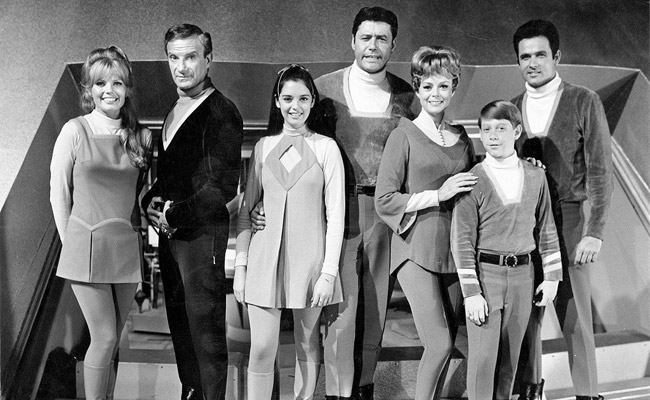
The first season of Lost in Space was in black-and-white, with the season finale including some color at the end, while Seasons 2 and 3 were in color. The series was inspired by the classic novel Swiss Family Robinson. The Robinson family’s spaceship spends the first season on one planet. At the start of Season 2, they are able to take flight again but crash land on another planet where the season takes place. With a format change in Season 3, the family traveled freely in seven episodes, visiting new worlds or encountering an adventure in space. A ‘space pod’ was introduced which allowed for transportation between the ship and planets as the family attempted to return to Earth or their original destination, the Alpha Centauri system. The third season theme song was also changed. A young composer named Johnny Williams composed the series’ theme songs before becoming more famous for his film scores as John Williams. The pilot, and much of Season 1, reused part of Bernard Herrmann’s score from The Day the Earth Stood Still. Williams also scored the incidental music for four episodes which helped gain him credibility as a composer. CBS had bought the rights to the show after turning down Star Trek. The original concept followed the Robinson family as they ventured around the planet, but the format changed to become a ‘Monster of the Week’ show. When ABC scheduled Batman opposite Lost in Space, the show embraced more campy elements to compete with the superhero series, with stories beginning to focus more on young Will Robinson, Dr. Smith and Robot, which did not make co-stars Guy Williams or Mark Goddard happy. The third season is infamous for an episode featuring a talking carrot. CBS never offered an explanation for the show’s cancellation, and the cast and crew expected to be renewed for a fourth season. The most likely reason was the ballooning costs of producing the show, with episodes going from about $131,000 in the first season to $165,000 by Season 3. The show was produced by 20th Century Fox, which was still suffering from the financial losses incurred by the feature film Cleopatra, which led to budget cuts across the board at the studio in an effort to stay afloat. Producer Irwin Allen was furious when he learned the budget for Season 4 would be cut by 15%, and he claimed the series could not continue with a reduced budget. The series did receive two Emmy nominations for Special Effects for Season 1, and Visual Arts and Makeup for Season 3.
CBS Thursday Night Movie encountered some issues during its early broadcasts. The series premiered with The Manchurian Candidate. On the September 30, 1965 airing of The Notorious Landlady, the reels got mixed up and the network had to issue an apology during a commercial break, resulting in a substantial portion of the film being replayed to get the continuity back on track, extending the 2 hour 15 minute broadcast to nearly three hours. In October when Elmer Gantry was broadcast, the 30-minutes of material cut from the 146-minute run time of the film resulted in viewer complaints that the film made no sense. Sunrise at Campobello was cut by nearly an hour to fit the network’s two-hour time slot, but many films still ran longer, pushing local newcasts well past their 11:00 PM start time. On the other side, Requiem for a Heavyweight was considered too short for broadcast at 85 minutes and CBS contacted the studio, Columbia Pictures, to pad the film with extra footage. Forty minutes of outtakes were in the studio vault and about ten minutes was added to the film, likely making it the first film to have footage added for television.
The Dean Martin Show was the second variety show hosted by Dean Martin, and spun off The Dean Martin Celebrity Roast specials that were part of the final season. Martin was reluctant to host the show, giving NBC a list of outrageous demands including not attending rehearsals and only working one day a week, Sunday, and simply announcing the acts. He also didn’t want to sing unless he felt like it. NBC agreed to every demand, and the schedule allowed Martin to star in a series of Matt Helm films as well as 1970’s Airport. Martin’s success came from not putting on airs. He read his lines from a cue card and refused to do a retake if there was flub. The mistake appeared on air.
Three episodes of Laredo were editing into the feature film Three Guns for Texas. Hank was an early example of a show with a true series finale, the underlying premise concluding with the final episode.
Indoor sets for Hogan’s Heroes were filmes at Desilu Studios, which became Paramount Studio for Season 4, and Cinema General Studios for the remaining seasons. While filmed in the generally warm climate of Southern California, the series was set in 1940s Germany in the winter, requiring the actors to wear warm clothes and pretending to be cold. There was always snow on the ground (salt during the first three seasons, and white paint for the rest) and frost on the windows. Actors in four major German roles were all Jewish, and three of them — Werner Klemperer (Klink), John Banner (Schultz), and Leon Askin (General Burkhalter) — had fled Nazi Germany before or during World War II. Robert Clary (LeBeau), a French Jew, spent three years in a concentration camp where his parents and other family members were killed. Other Jewish actors including Harold Gould, Harold J. Stone and Lousie Troy also played German roles. Two versions of the pilot were presented to test audiences, one without a laugh track and one with, with the laugh track scoring better with the audience. As a result, the show was aired with a laugh track, and CBS began incorporating laugh tracks into all of its comedic series. Writers of the 1951 play Stalag 17, which became a 1953 feature film, sued Bing Crosby Productions for copyright infringement, but the lawsuit was unsuccessful. A jury actually found in favor of the plaintiffs, but a judge overruled the decision citing significant difference in the dramatic mood of the two works (though there is an undeniable similarity between the two).
Honey West was the first network TV series to have a female character’s name as the title. Star Anne Francis first played the character in an episode of Burke’s Law, which led to the series being commissioned as a spin-off. West was intended to be the American equivalent of Cathy Gale and Emma Peel from the British series The Avengers. Goldfinger actress Honor Blackman was producer Aaron Spelling’s first choice for the role, but she turned it down. Nolan Miller designed West’s fashions.
The Smothers Brothers Show was the last CBS sitcom filmed in black-and-white. Tom Smothers often fought with studio executives over creative control. Outside of one episode, the brothers never played their instruments, and it wasn’t until halfway through the first season that they sang the theme song.
The Wild Wild West was a mash-up of genres including Western, spy and sci-fi, and the series was conceived as ‘James Bond on horseback’ as the TV Western genre was on the wane. Combining the Victorian era with Jules Verne-like technology, the series has been cited as an influence on the steampunk genre. Despite the series’ high ratings, it was cancelled as a concession to Congress over television violence. Every episode title began with ‘The Night’, except for the first season episode ‘Night of the Casual Killer’. Star Robert Conrad performed most of his stunts because the time required to set up a shot for a stuntman was slowing down production. Unfortunately, one Season 3 stunt went wrong, leaving Conrad with a concussion and hospitalized for 72 hours in intensive care. As a result, production on the season ended two weeks early as Conrad spent weeks in the hospital. The episode was eventually completed and aired during Season 4, with footage of the fall left in. The accident made Conrad adamant that Season 4 would be his last, and he was doubled for the more dangerous stunts although he still participated in fight scenes. Co-star Ross Martin portrayed over 100 different characters and dozens of dialects as Artemus Gordon. Martin earned an Emmy nomination for his work in 1969. Martin broke his leg filming a Season 4 episode, and suffered a heart attack after completing ‘The Night of Fire and Brimstone’. His character was replaced with characters played by Charles Aidman (four episodes), Alan Hale Jr., and William Schallert (two episodes), while Conrad worked solo for two episodes. Martin returned in mid-December to film the final three episodes of the series. Agnes Moorehead won an Emmy for her guest role as villain Emma Valentine. The first season was filmed in black-and-white and was darker in tone. With the switch to color, the show became notably campier. The train used in the pilot, which was also known as the Hooterville Canonball on Petticoat Junction, was actually built 15-20 year after the setting of the show, an appropriate anachronism. A different train, built in 1875, was used when the series went into production. The series is generally set from the years 1869 to 1877.
Get Smart was created to capitalize on the success of James Bond and Inspector Clouseau. The show was pitched to ABC executive which called it ‘un-American’ and demanded a lovable dog be added to give the show heart, as well as adding Maxwell Smart’s mother. Co-creator Mel Brooks strongly objected to the second suggestion. Brooks had little involvement with the show after the first season, while Buck Henry served as story editor through 1967. While cast and crew contributed joke and gadget ideas, especially star Don Adams, dialogue was rarely ad-libbed until one episode where guest star Don Rickles encouraged Adams to misbehave. The ad-lib was so successful, the single episode was turned into two parts. The series won seven Emmy awards during its run, earning two for Comedy series, with Don Adams also winning three for Actor in a Comedy Series.
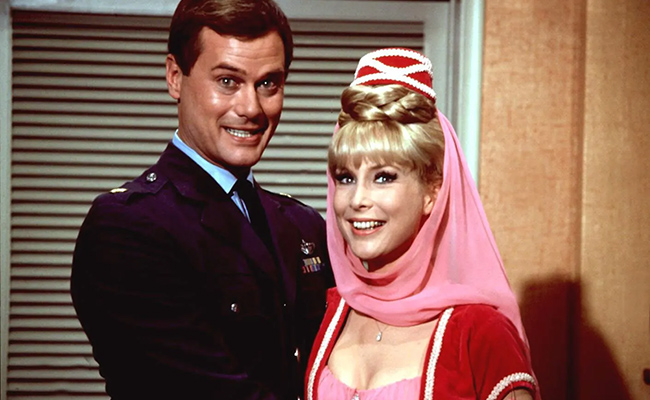
Season 1 of I Dream of Jeannie was filmed in black-and-white, one of only two network shows in black-and-white at the time, and the episodes have since been colorized for Syndication. The reason for the format was to accommodate the show’s special effects, which were then possible to do in color for Season 2. NBC also did not want to pay the additional expense for color because execs did not believe it would be successful enough for a second season. Producer Sidney Sheldon offered to pay the extra cost for the color processing but was told to not throw his money away. Star Barbara Eden also portrayed Jeannie’s evil sister, Jeannie II, in several episodes between Seasons 3 and 5. Jeannie’s mother was played by Florence Sundstrom in Season 1 Episode 2, Lurene Tuttle in Season 1 Episode 14, and by Eden in Season 4 Episodes 2 and 18. Eden’s then-husband Michael Ansara appeared across the series as The Blue Djinn, King Kamehameha and Major Biff Jellico. He also directed the penultimate episode of the series. The series was created as a response to the success of Bewitched on ABC, and was inspired by the feature film The Brass Bottle, which co-starred Eden but as a human (Burl Ives played the genie). Sheldon could not find an actress to play Jeannie, and had one rule — she could not be blonde because it would make the character too similar to Samantha on Bewitched. After many unsuccessful auditions, he called Eden’s agent. The show’s animated opening did not appear until several episodes after the pilot, and was expanded after the transition to color. The animation was created by Friz Freleng. Though set in Florida, the cast and crew only made two visits to the state, though for promotional appearances rather than filming. Jeannie’s original origin had her as a regular human turned into a genie by the Blue Djinn, and her family are ‘just peasants from the old country’. The origin was retconned in Season 3 with dialog suggesting she had always been a genie, and her relatives are depicted as genies, including her mother after Eden assumed the role. The first season’s jazzy theme music and instrumental score by Richard Wess was disliked by Sheldon. A new theme song with lyrics was composed by Hugo Montenegro for the second season, but the lyrics were never used. Jeannie’s iconic bottle was actually a Christmas 1964 Jim Beam liquor decanter. While the origin of who discovered the bottle varies, evidence suggests Season 1 director Gene Nelson saw one in a liquor store and brought it to Sheldon. The original bottle was dark green with a gold leaf pattern, and since it was in black-and-white, colors and patterns were not necessary. From Season 2, the bottle was painted purple with intricate patterns. For the colorized Season 1 episodes, an attempt was made to make the bottle look purple to match the look of the color episodes. The smoke effect from the bottle was generally a special effect overlay, but some time later in the color episodes a live smoke pack was lifted out of the bottle on a wire. It is unknown how many bottles were used during production, but some estimates put it at twelve. Eden was given the stunt bottle on the last day of filming. Co-stars Larry Hagman and Bill Daily were also believed to have bottles. In the third to last episode when Dr. Bellows discovers Jeannie’s secret, her bottle is broken. This was intended to be the series’ final episode, but for some reason it was broadcast third to last.
The Wackiest Ship in the Army was loosely based on the film of the same name, and is often attributed as a comedy though it violates three unwritten rules for television comedy — it was an hour in length, it had no laugh track, and characters were sometimes killed.
1975
- September 14 – Three for the Road (CBS, One season, 12 episodes)
Three for the Road was the first 60-minute dramatic series produced by MTM Enterprises. It starred Alex Rocco, Vincent Van Patten and Leif Garrett.
1985
Witt/Thomas/Harris Productions
- September 14 – 227 (NBC, Five seasons, 116 episodes)
- September 14 – Adventures of the Gummi Bears (NBC, Six seasons, 65 episodes)
- September 14 – The Golden Girls (NBC, Seven seasons, 180 episodes)
- September 14 – It’s Punky Brewster (NBC, Two seasons, 26 episodes)
- September 14 – The Berenstain Bears (CBS, Two seasons, 26 episodes)
- September 14 – Jim Henson’s Little Muppet Monsters (CBS, One season, 13 episodes, 10 unaired)
- September 14 – The Wuzzles (CBS, One season, 13 episodes)
- September 14 – The Care Bears (Syndication, One season, 11 episodes)
- September 16 – Break the Bank (Syndication, One season, 180 episodes)
- September 16 – Jayce and the Wheeled Warriors (Syndication, One season, 65 episodes)
- September 18 – Charlie & Co. (CBS, One season, 18 episodes, 1 unaired)
- September 18 – The Equalizer (CBS, Four seasons, 88 episodes)
- September 18 – George Burns Comedy Week (CBS, One season, 13 episodes)
- September 18 – Stir Crazy (CBS, One season, 8 episodes, 1 unaired)
- September 20 – Spenser: For Hire (ABC, Three seasons, 66 episodes, 4 TV movies)
227 was adapted from the stage play Two Twenty Seven. The play’s setting was changed from Chicago to Washington DC for the series, and was created as a starring vehicle for Marla Gibbs, who was still on The Jeffersons at the time. The show was expected to debut in 1986, but the sudden cancellation of The Jeffersons made Gibbs available and production began a year earlier than planned. Gibbs, Hal Williams, Alaina Reed Hall and Regina King appeared in all five seasons. Breakout star Jackée Harry departed after Season 4, but appeared as a guest in Season 5. Helen Martin and Curtis Baldwin were recurring in Season 1 as Pearl Shay and Calvin Hobbs, and were promoted to regulars beginning in Season 2. Martin was the only cast member to appear in all 116 episodes, which included the backdoor pilot Jackée. Harry received two Emmy nominations and won in 1987 for Supporting Actress in a Comedy Series. She was also nominated for the Golden Globe in 1989. These were the only Emmy or Golden Globe recognitions for the series.
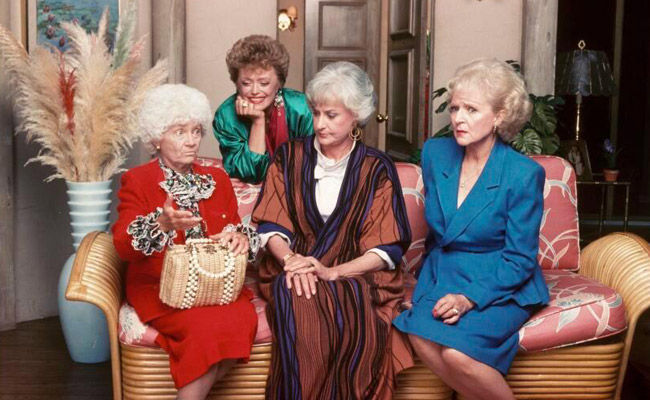
The Golden Girls is only one of four sitcoms in which each of its leads won an Emmy Award. The series ended when Bea Arthur chose to leave, which led to the ill-fated spin-off, The Golden Palace, on CBS. The pilot included a gay houseboy, Coco, who lived with the women. The character was eliminated after the pilot. Estelle Getty was the first actress cast in the role of Sophia Petrillo. Getty underwent three hours of makeup to transform into the eldery woman. Getty endured stage fright during her entire time on the show, also intimidated by working with stars like Arthur, Rue McClanahan and Betty White. White and McClanahan came into consideration after the cancellation of Mama’s Family, with McClanahan up for the role of Rose, and White considered for Blanche, based on roles they had previously played. Eager to not be typecast, they switched roles at the last minute under the advisement of director Jay Sandrich. In the pilot, Dorothy was intended to be Southern, which perplexed McClanahan who had devised the accent for Blanche. New director Paul Bogart felt exactly the opposite and insisted McClanahan use a Southern accent, which she then deliberately exaggerated to be a Southern heroine like Scarlet O’Hara. Elaine Stritch was originally envisioned for the role of Dorothy, meant to be a Bea Arthur type, but her audition flopped. Producers assumed Arthur would not be interested and asked McClanahan to approach her former Maude co-star. Arthur loved the script but did not want the show to be ‘Maude and Vivian meet Sue Ann Nivens’. She reconsidered when she learned McClanahan and White had swapped roles. Arthur and White worked toegther with respect, but have been alleged to dislike each other intensely off-camera as White would often break the fourth wall and joke with the audience, which Arthur found unprofessional. Arthur is said to have referred to White as the C-word on many occasions, and White later asserted it was her perky demeanor that got on Arthur’s nerves. In any case, Arthur insisted the four women take lunch breaks together. A Season 6 episode which featured a commitment ceremony for Blanche’s gay brother and his partner led to death threats for the show’s writers, Marc Cherry and Jamie Wooten. The series received a total of 68 Emmy Awards nominations with 11 wins. All four actresses were named Disney Legends in 2009.
The Equalizer received six Emmy nominations, four for star Edward Woodward. He won the Golden Globe in 1987. George Burns was 89 at the time anthology series George Burns Comedy Week premiered, and his involvement with the series was limited to lending his name, introducing the night’s program and providing occasional voice-over narration. He did not act in any of the episodes. Stir Crazy was based on the 1980 film of the same name, with the theme song ‘Stir It Up’ performed by Patti LaBelle.
Spenser: For Hire was filmed largely in Boston and was estimated to have generated $50 million for the Commonwealth of Massachusetts. The show ended mainly because of the costs of filming on location. Co-star Avery Brooks was spun-off into his own series, A Man Called Hawk, following the end of the series.
1995
- September 14 – Charlie Grace (ABC, One season, 9 episodes)
- September 15 – Maybe This Time (ABC, One season, 18 episodes)
- September 15 – Strange Luck (FOX, One season, 17 episodes)
- September 16 – Santo Bugito (CBS, One season, 13 episodes)
- September 16 – The Twisted Tales of Felix the Cat (CBS, Two seasons, 21 episodes)
- September 16 – Masked Rider (FOX Kids, Two seasons, 40 episodes)
- September 16 – Brotherly Love (NBC, Two seasons, 40 episodes)
- September 16 – Minor Adjustments (NBC, One season, 20 episodes)
- September 16 – Night Stand with Dick Dietrick (Syndication, Two seasons, 96 episodes)
- September 16 – U.S. Customs: Classified (Syndication, One season, 16 episodes)
- September 17 – Almost Perfect (CBS, Two seasons, 34 episodes, 6 unaired)
- September 17 – The Client (CBS, One season, 22 episodes)
- September 18 – Can’t Hurry Love (CBS, One season, 19 episodes)
- September 18 – George & Alana (Syndication, One season, last broadcast on March 29, 1996)
- September 19 – Hudson Street (ABC, One season, 22 episodes)
- September 19 – Murder One (ABC, Two seasons, 41 episodes)
- September 19 – The Pursuit of Happiness (NBC, One season, 13 episodes, 7 unaired)
2005
Bays Thomas Productions
- September 14 – Head Cases (FOX, One season, 7 episodes, 5 unaired)
- September 16 – Twins (The WB, One season, 18 episodes)
- September 16 – Threshold (CBS, One season, 13 episodes, 4 unaired)
- September 17 – Coconut Fred’s Fruit Salad Island (Kids’ WB, Two seasons, 13 episodes)
- September 17 – Loonatics Unleashed (The WB/The CW, Two seasons, 26 episodes)
- September 17 – Johnny Test (Kids WB, Six seasons, 117 episodes)
- September 17 – The Showbiz Show with David Spade (Comedy Central, Three seasons, 39 episodes)
- September 18 – Life with Derek (Disney Channel, Four seasons, 70 episodes)
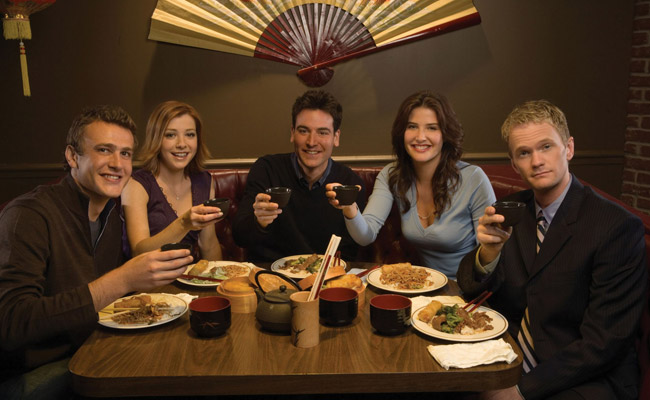
- September 19 – How I Met Your Mother (CBS, Nine seasons, 208 episodes)
- September 19 – Out of Practice (CBS, One season, 22 episodes, 8 unaired)
- September 19 – Just Legal (The WB, One season, 8 episodes)
- September 19 – Surface (NBC, One season, 15 episodes)
- September 19 – Kitchen Confidential (FOX, One season, 13 episodes)
- September 20 – My Name Is Earl (NBC, Four seasons, 96 episodes)
2015
- September 14 – FABLife (Syndication, One season, 180 episodes)
- September 14 – Crime Watch Daily (Syndication, Three seasons, 580 episodes)
- September 14 – Crazy Talk (Syndication, One season, 60 episodes)
- September 15 – The Bastard Executioner (FX, One season, 10 episodes)
- September 15 – Best Time Ever with Neil Patrick Harris (NBC, One season, 8 episodes)
- September 16 – Moonbeam City (Comedy Central, One season, 10 episodes)
- September 18 – Descendants: Wicked World (Disney Channel, Three seasons, 33 episodes, 3 specials)
- September 18 – PJ Masks (Disney Junior, Six seasons, 151 episodes to date)
- September 20 – Dash Dolls (E!, One season, 8 episodes)