


Lifetime
So it’s come to this. Lifetime is now blatantly ripping itself off. Have we finally run out of ‘Based on True Events’ movies? It sure seems that way with the latest mystery thriller, Girl Who Vanished (they couldn’t even be bothered to put a ‘The’ at the beginning of the title). Why does this movie seem so familiar? Why it’s because a nearly identical story was broadcast back in June, less than four months earlier, as The Boy Who Vanished (yeah, that one got the ‘The’). Perhaps Lifetime felt weird about the earlier film since it was about a boy, not the gender that usually heads one of the network’s movies. So they did a swap and gave us nearly the same story of a child gone missing a decade earlier, turning up at the police station after having escaped her captor at a gas station, the parents certain this is their child so there’s no reason for a DNA test, don’t bring it up again, okay? A mother knows her own flesh and blood, right?
In The Boy Who Vanished, the boy actually was the missing son but he was also involved in some sort of revenge scam that he ultimately felt bad about and revealed the truth to his family. In Girl Who Vanished, things are a little more complicated though no less similar. The story starts when Emily Tanner shows up at the police station to the shock of her family. They bring her home and everything seems fine, she remembers the house — mom Kate refused to move just in case Emily ever did return — but she has no idea that her parents have been torn apart by her disappearance, but Kate insists husband Matt stay the night, on the couch, just to keep up appearances until they can break the news to Emily. Younger sister Lily, though, has felt that nothing is right about Emily from the beginning, and is gobsmacked that her mother refuses to get a DNA test. She confides in her friend, Dee, at school how she feels and how crazy her mom is acting, and while Dee knows that Kate can be a little extra, she urges Lily to just give her some consideration because she is going through a lot right now, as both Lily and Matt are.
Lifetime
Returning home one day and faced with a bevy of local media, Lily notices a strange man standing beside a car parked in front of the house. They are also greeted by a true crime podcaster, Naomi Ackerman, who uses her program to help the victims and survivors of crimes similar to what Emily went through. Kate refuses, saying they will make a statement when the time is appropriate, but Lily keeps pressing her to let Emily do the podcast. When Kate relents, the interview seems to go well, but Kate gets triggered by a question and shuts it down. Emily now feels more than ever that something is sketchy about Emily, and decides to go through some of their old toys, rabbits she calls Flopsy and Mopsy, reminiscing about how she and Emily would spend hours playing in their treehouse, Emily adding how they enjoyed their tea parties and how Lily always held her pinkie in the air. They didn’t have a treehouse, and the bunny Emily is holding is named Hopper. Busted. And now Lily has to convince her mother that this person in their house is not Emily, which Kate refuses to hear. And to shut Lily up, she finally does the DNA test, which Emily passes with flying colors. But how is that possible? Lily finally confronts the strange man she’s been seeing, and he turns out to be the police officer who originally worked the kidnapping case. He reveals some unknown facts to Lily, notably that there was some blood on the staircase the night Emily disappeared. Someone tried to clean things up, but they missed a few spots. This reinforces her beliefs that Emily is not who she says she is, but when she brings up the man to her parents, they reveal to her that he was kicked off the case for making wild accusations and because he had a drinking problem. Well, that puts Lily into a tailspin. Who can she trust at this point, especially since ‘Emily’ knows she knows the truth about her. When Lily sees the former cop again, she goes at him about his lies, but he insists he’s telling the truth and that someone in the house had something to do with Emily’s disappearance. He asks her is there have been any additions to the house since then, someplace the body could be hidden. Lily says there has not been anything added and tells him to leave her alone. But strange things begin to happen. Emily’s therapist, whom Lily was supposed to talk to to sort out her feelings, was suddenly murdered during what appeared to be an attempted robbery as she left her office one night. A man Emily was seen talking to outside of the house, someone she’s in cahoots with, is murdered at his hidden mobile home. Matt shows up at dinner with his hand bandaged, suggesting to Emily that he may have had something to do with the death of the therapist. (The former cop also ends up dead before the whole thing is over.) Beginning to rethink what she had been told, Lily goes through some old photos and finds one of her and Emily as little girls standing by a tree in the front yard. She holds the photo up and matches the position of the tree, and when she removes the photo from view … there is an addition — a raised flower bed. Assuming the worst, Lily begins to dig in the dirt, confronting her fear — the body of her sister. And Kate isn’t happy that Lily tore up her flowers, and the grave. But will Lily become more fertilizer, or will Emily be able to step up and save her ‘sister’, revealing the truth in the process?
The similarities between The Boy Who Vanished and Girl Who Vanished are striking, with just a couple of changes to set them apart. The main difference is the identity of the returned child, and the twist being the real child is dead — during an argument Kate grabbed her arm in a fit of anger but Emily fell down the hardwood staircase, hitting each and every step on the way down — and the parent is playing along because this puts her completely in the clear. There was also a nice explanation for the success of the DNA test that made sense (it had to be some family member’s DNA). The reveal that the real Emily was dead all along is really the film’s most shocking moment and helps elevate it above just being a cheap imitation, so kudos to screenwriter Daniel West for not just ripping off the previous film and changing the gender of the kidnapped child. Director David Benullo also gets credit for keeping the suspense building to that shocking reveal, and for getting really good performances from most of his cast.

Lifetime
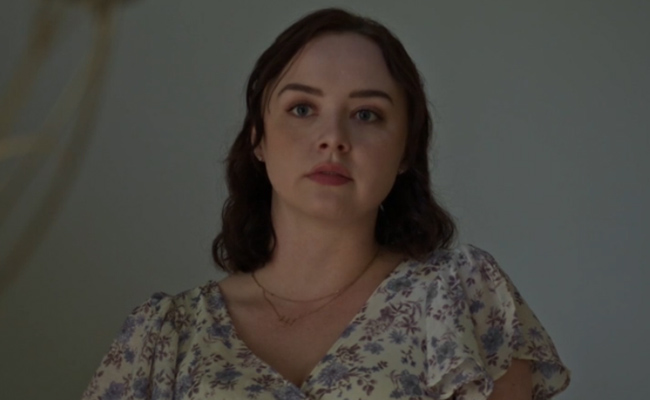
As for that cast, Rylee Reagan is terrific as Lily (even though she looks more college-age than high school). She’s the only one who thinks sensibly throughout the entire movie (until we learn the truth, then Kate’s behavior does make sense). She’s always questioning, always frustrated at being stonewalled, even when she knows Emily is not her sister. That moment where she talks about the treehouse and her reaction to Emily is pure gold. Isabella Carlsen is also terrific as (fake) Emily. She plays the character as if she is pretty sure Lily doesn’t believe her so she has to play it up for Kate so she doesn’t get suspicious (unaware of what she’s really walked into). It is an interesting concept that Lily is trying to convince Kate that Emily is not Emily, and Emily is trying to convince Kate that she is and Lily is just jealous, with neither of them aware that Kate already knowns ‘Emily’ is not Emily. They all do a great job of fooling the audience as well.
Jon Eric Hoffman is fine as Matt, but he has very little to do except show up at key moments. It’s not even clear if he knows Emily is really dead (spoiler alert — he had nothing to do with the murders of the therapist or the cohort), and there is no mention of him being arrested in the final moments. Phil Talamonti is a bit mysterious and one-note, offering drips and drabs of information to Emily instead of just coming out and telling her what he believes (blame that on the writing), so he doesn’t have a lot to work with. Alfred Lamar as Officer Bowen, Lisha Hackney as therapist Dr. Salazar, Jessica DeBonville as podcaster Naomi Ackerman, and Charlotte Banks as Dee, all do well with their small roles, making their characters feel authentic. If there is a weak link in the bunch, it’s Chelsea Gilson as Kate. As played by Gilson, Kate is a pretty blank slate, reciting her dialog in a mostly monotone voice, seemingly unable to register an ounce of emotion on her face. Watch her try to raise her eyebrows when she’s attempting to be agitated about something. She can occasionally squint a bit to register anger, but it seems to be a real chore. Not saying that she hit a Botox party before filming, but there is something going on here that limits her emotional range, making her performance a bit robotic.
If Girl Who Vanished wasn’t so derivative of The Boy Who Vanished, it could have been a three-star movie. It has a decent twist that does elevate it to extremely watchable, with a very mixed bag of performances. It’s still a fun watch thanks to the twist and the performances of Rylee Reagan and Isabella Carlsen.
Girl Who Vanished has a run time of 1 hour 28 minutes, and is rated TV-14.