Michael White Productions
This week across the decades gave the world many notable films with actors and directors making their debuts, and awards organizations looking favorably on many. 1925 had two major silent films with two major stars, Charlie Chaplin and Lon Chaney. A 1935 film revived the career of its leading actress. 1955 had films that depicted a real life political assassination, told the story of a war hero who became an actor — with the actor playing himself, and a controversial film that was adapted into a TV soap opera. 1965 took much of the Beach Party cast to the military, and saw Disney rehire a popular actor after previously firing him. 1985 gave the world a comedic zombie horror film that went on to inform future zombie projects, 1995 brought a videogame to life for the first time, 2005 produced a raunchy comedy about a man with a secret, and 2015 told the story of a real life rap group. All of these pale in comparison to one 1975 movie musical which has a huge cult following and is still seen in movie theaters today. Scroll down to see all of the films released this week across the decades, and tell us if any of your favorites are celebrating milestone anniversaries.
1925
Charles Chaplin Productions
- August 15 – Children of the Whirlwind (USA, Whitman Bennett Productions)
- August 15 – The Girl Who Wouldn’t Work (USA, B.P. Schulberg Productions)
- August 15 – Off the Highway (USA, Hunt Stromberg Productions)
- August 15 – The Price of Success (USA, Waldorf Pictures Corporation)
- August 16 – Rough Going (USA, Independent Pictures)
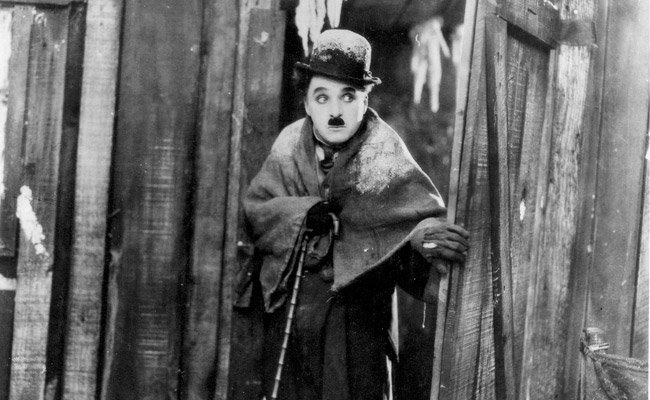
- August 16 – The Gold Rush (USA, Charles Chaplin Productions)
- August 16 – The Half-Way Girl (USA, First National Pictures)
- August 16 – The Isle of Hope (USA, Richard Talmadge Productions)
- August 16 – The Unholy Three (USA, Metro-Goldwyn-Mayer)
- August 16 – Winds of Chance (USA, First National Pictures)
- August 17 – Rugged Water (USA, Famous Players-Lasky Corporation)
- August 19 – The Wanderer (USA, Famous Players-Lasky Corporation)
The Half-Way Girl and Rugged Water are considered lost films, while the survival status of Children of the Whirlwind, Off the Highway and The Isle of Hope is unknown.
Prints of The Girl Who Wouldn’t Work and The Price of Success are preserved at the Library of Congress. Rough Going is preserved in the Library of Congress collection and at Cinematheque Royale de Belgique, Bruxelles (Brussels).
Charlie Chaplin reworked The Gold Rush in 1942, adding sound effects, a musical score and narration, receiving an Oscar nomination for Best Music Score and Best Sound Recording. The 1925 film was selected for preservation in the National Film Registry in 1992. The film’s opening scene was shot in the snow country of the Sierra Nevada, with 600 extras traveling up the 2300-foot pass dug through the mountain snow. The rest of the film was shot in Hollywood where elaborate Klondike sets were built.
The Half-Way Girl was filmed around the Jersey Shore. The fire aboard an ocean liner scene was filmed in color. First National Pictures bought the World War I cargo ship The Corvalis for a fraction of its original cost for the sole purpose of blowing it up in the film. The stern remained afloat and had to be sunk by the Coast Guard. Blowing up the ship saved about $25,000 in costs for building and destroying miniatures.
The Unholy Three marked the beginning of a collaboration between Lon Chaney and director Todd Browning that would span eight films during the silent era. Chaney and co-star Harry Earles reprised their roles in a 1930 sound remake, the only film to include Chaney’s voice as he died shortly after filming. Browning was adept at trick photography, at one point using a three-foot tall chimp to portray a rampaging ape using forced perspective.
Prints of Winds of Chance are located at the UCLA Film and Television Archives, George Eastman House, and National Archives of Canada (at Ottawa). An incomplete print of The Wanderer survives.
1935
- August 14 – Manhattan Butterfly (USA, Cameo Pictures)
- August 15 – Alice Adams (New York City, RKO Radio Pictures)
- August 15 – Jimmy Boy (London, Baxter and Barter Productions)
- August 15 – The Man from Guntown (USA, Nat Ross Productions)
- August 15 – Trails End (USA, Black King Productions Inc.)
- August 16 – Together We Live (USA, Bryan Foy Productions)
- August 17 – We’re in the Money (USA, Warner Bros. Pictures)
- August 18 – Radio Pirates (UK, Sound City)
- August 19 – Westward Ho (USA, Paul Malvern Productions)
- August 19 – Where’s George? (UK, British and Dominions)
Alice Adams entered wide release in the US on August 23, 1935. Radio Pirates and Where’s George? have no known US theatrical release dates.
A silent version of Alice Adams, based on the Booth Tarkington novel, was made in 1923. Katharine Hepburn wanted George Cukor to direct the 1935 version but he was busy with David Copperfield. Cukor suggested William Wyler, but producer Pandro S. Berman favored George Stevens. Berman wanted a happy ending for the film, which differed from the novel, and consulting with Cukor he agreed the original ending would be box office poison so it was changed over the objections of Stevens and Hepburn. Hepburn had experienced a career downturn after 1933’s Morning Glory and Little Women, but her performance in Alice Adams made her popular again, earning an Oscar nomination in the process along with the film’s Best Picture nomination. Bette Davis won the Oscar but said that Hepburn deserved it.
Working titles for Together We Live were Call to Arms and The Soldier Story. The film was produced during and set against the 1934 West Coast waterfront strike in San Francisco. Actors Willard Mack and Lou Tellegen had died by the time the film was released, and therefore received lower billing than originally anticipated.
We’re in the Money was one of five Warner Bros. films that paired Joan Blondell and Glenda Farrell as a blonde bombshell comedy duo.
Radio Pirates is also known as Big Ben Calling. King George V died just a few weeks after Where’s George? was released, so the film’s title was changed to The Hope of His Side as posters featuring the original title were not appropriate. Two hundred unemployed coal workers in the mining town of Featherstone were hired as extras. Players from Featherstone Rovers and Huddersfield were used in the rugby scenes.
1945
- August 15 – Secrets of a Sorority Girl (USA, Producers Releasing Corporation)
- August 16 – Rustlers of the Badlands (USA, Columbia Pictures)
- August 16 – Tell It to a Star (USA, Republic Pictures)
- August 17 – Lady on a Train (USA, Universal Pictures)
- August 17 – Stagecoach Outlaws (USA, Sigmund Neufeld Productions)
- August 17 – The Strange Affair of Uncle Harry (USA, Charles K. Feldman Group)
- August 18 – Divorce (USA, Monogram Pictures)
Rustlers of the Badlands was the fourth of 65 films in the ‘Durango Kid’ series. Lady on a Train received an Oscar nomination for Best Sound. The Strange Affair of Uncle Harry is also known as Uncle Harry and The Zero Murder Case.
1955
- August 14 – The Phenix City Story (USA, Bischoff-Diamond Corporation)
- August 15 – A Kid for Two Farthings (UK, London Film Productions)
- August 17 – To Hell and Back (USA, Universal Pictures)
- August 18 – Love Is a Many-Splendored Thing (USA, Twentieth Century Fox)
- August 19 – Female on the Beach (USA, Universal International Pictures)
A Kid for Two Farthings was released in the US on April 17, 1956. Female on the Beach first opened in France on July 27, 1955.
The Phenix City Story depicts the real-life 1954 assassination of Albert Patterson, who had just been nominated as the Democratic candidate for Alabama Attorney General on a platform of cleaning up Phenix City, a city controlled by organized crime, and the imposition of martial law by the state government. The film was selected for preservation in the National Film Registry in 2019.
A Kid for Two Farthings was one of the last films produced by Alexander Korda before his death. It was director Carol Reed’s first film in color.
Audie Murphy played himself in war film To Hell and Back, which was based on his own World War II experience. Murphy did not want to star in the film and had suggested Tony Curtis, but the director and producer convinced him to take the role despite at the age of 30 he would be playing himself between the ages of 17 and 20. Murphy alarmed the crew when he brought real loaded firearms to the set instead of using the prop guns, an incident attributed to his PTSD. Murphy attempted to get a sequel made dealing with his post-war life but could never get a script that interested investors.
Love Is a Many-Splendored Thing was the inspiration for the 1967 soap opera of the same name, but without the hyphen. The film struggled to get Production Code approval due to its themes of adultery and miscegenation. Parts of the film were shot on location in Hong Kong, which was unusual for the time. Two weeks of filming had been completed before the final screenplay was completed, which then had to be adapted to include as much of the location footage as possible. Stars William Holden and Jennnifer Jones could barely tolerate each other off camera, despite their chemistry on. Holden once claimed Jones chewed garlic before their love scenes to discourage him. The film earned eight Oscar nominations including Best Picture and Actress, winning for Best Costume Design – Color, Best Score and Best Song.
1965
- August 14 – A Very Special Favor (USA, The Lankershim Company)
- August 18 – Sergeant Deadhead (USA, Alta Vista Productions)
- August 18 – The Monkey’s Uncle (USA, Walt Disney Productions)
Although star Rock Hudson’s production company co-produced A Very Special Favor, he felt sex comdies had already run their course and he felt the movie was filthy from the moment he read the screenplay.
Sergeant Deadhead starred Frankie Avalon and many cast members from the Beach Party movies, including Deborah Walley, Harvey Lembeck, and Buster Keaton in larger roles, with Dwayne Hickman, Alberta Nelson, Michael Nader, Luree Holmes, Patti Chandler, Andy Romano and Bobbi Shaw in small roles throughout the film. Tommy Kirk was originally announced to star, but Avalon got the role instead, part of a deal in which the studio would exercise its option on Avalon’s services to make two films a year for four years. The script did not include any written gags for Keaton, instead just giving him a suggestion for which he would create something on his own and show it to the director. The sequel Sergeant Deadhead Goes to Mars was announced before the film was released, but it was never produced.
The Monkey’s Uncle is a sequel to The Misadventures of Merlin Jones. The Monkey’s Uncle marks the last film Tommy Kirk and Annette Funicello made for Disney (though Funicello returned in 1985 for TV movie Lots of Luck). Future Lost in Space star Mark Goddard made his feature film debut in the movie. Following the first film, Kirk had been fired by Disney due to his homosexuality and drug addiction, but re-hired him for the sequel. Kirk revealed he was high on pills during both productions, and blacked out during one scene in which he was to be holding his breath. The credited writers are Tom and Helen August, which were pseudonyms used by blacklisted writers Alfred Lewis Levitt and Helen Levitt. The home video release restored their names. The Sherman Brothers wrote the film’s title song, performed by Funicello and pre-fame The Beach Boys. Funicello regarded the recording session as the highlight of her Disney career.
1975
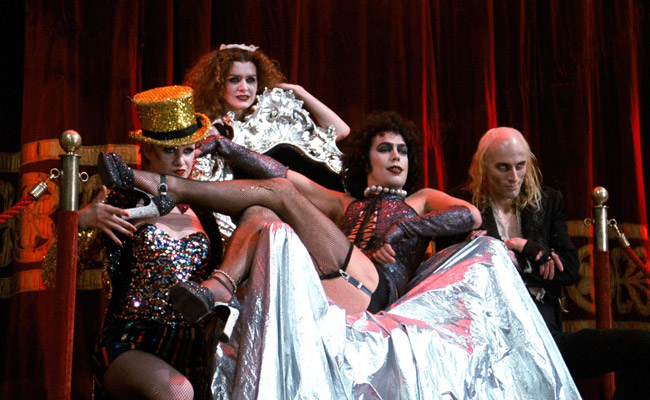
- August 14 – The Rocky Horror Picture Show (UK, Michael White Productions)
- August 15 – Royal Flash (London, Two Roads Productions)
- August 20 – Coonskin (USA, Bakshi Productions)
- August 20 – Russian Roulette (USA, Bulldog)
The Rocky Horror Picture Show was released in the US on September 29, 1975. Royal Flash was released in the US on October 10, 1975, and general release in the UK on October 11.
The Rocky Horror Picture Show marked the film debut of Tim Curry. The castle used in the film was Oakley Court, known for its use in several Hammer films, which is now an upscale hotel. While the film parodies and honors kitschy sci-fi and horror films, costume designer Sue Blane did no research, and notes her creations affected the development of punk rock fashion. The film was not a box office success, and audiences only began to take note when the Waverly Theater in New York City began midnight screenings, which became so popular that audience members began to arrive in costume, were talking back to the film and performing alongside it at the same time. Still enjoying midnight engagements to this day, it is the longest-running theatrical release in film history (after Fox was acquired by Disney, the Fox policy of making archival prints available at any time was revoked but Disney made an exception for Rocky Horror). The film was selected for preservation in the National Film Registry in 2005. Legend has it that director Jim Sharman was offered a much larger budget by 20th Century Fox if he cast well-known actors, but he insisted on using the original London cast, and accepted American actors Barry Bostwick and Susan Sarandon as Brad and Janet, changing the story’s setting to a town in the US. The film’s opening title sequence was intended to feature clips from the films mentioned in ‘Science Fiction Double Feature’, but it was deemed too expensive and scrapped, replaced with what would become the iconic lips against a black background. On the stage production, the actors did their own make-up, but for the film Pierre La Roche, make-up artist for Mick Jagger and David Bowie, was hired to redesign the make-up for each character. Many props and set pieces were reused from old Hammer films, which helped lower the costs and enhanced the film’s cult status. The tank and dummy used for Rocky’s birth originally appeared in The Revenge of Frankenstein (1958). Sue Blane did not want to work on the film until she learned Curry was committed. The two had worked together on a production of the play The Maids, in which Curry wore a corset, and Blane arranged for the theatre to loan her the corset for the film. Blane also admits that her costumes for Brad and Janet were just based on how she thought Americans dressed. Having to double up on costumes increased the budget as two identical corsets had to be used for the pool scene, with the actors wearing one corset while the other dried. Many costumes were taken directly from the stage production, while others were new to the film such as Columbia’s gold sequinned swallow-tail coat and top hat, and Magenta’s maid’s uniform. Blane was surprised and honored by how faithful the fans have been in recreating her designs, originally fearing they would be tacky. Patricia Quinn (Magenta) provided the lips for the opening titles (she believed she was also going to sing the song, as she did in the stage production as Trixie the Usherette) with Richard O’Brien (Riff Raff) providing the vocals. The image of the female lips and male voice enhanced the film’s theme of androgyny. The lips on the second movie poster belonged to former Playboy model Lorelei Stark. For the film’s 50th anniversary, Disney has meticulously restored the film over a 10-month period to produce a new 4K master that will be released theatrically and to home video. A sequel was proposed in 1979, Rocky Horror Shows His Heels, to feature the original cast and include the original crew, but director Sharman didn’t want to revisit the concept so closely and Curry did not want to reprise his role as Frank-n-Furter. Instead, Sharman and O’Brien conceived a stand-alone film with little continuity from the original, Shock Treatment, that featured the characters of Brad and Janet in the town of Denton. O’Brien, Quinn and Nell Campbell returned in new roles, but Curry, Bostwick and Sarandon did not. The film was not well-received by fans but has grown its own cult following. O’Brien produced a stage version of the sequel in 2015, and attempted another Rocky Horror sequel for the stage but the project went dormant in 2001. A woefully misguided remake of Rocky Horror was attempted by the Fox television network in 2015. The less said about that, the better.
Bob Peck and Christopher Cazenove made their debuts in Royal Flash. The film was cut from 118 to 102 minutes before release, losing two flashback scenes and the entire role of Roy Kinnear.
Coonskin references the Uncle Remus folk tales, and satirizes the blaxploitation genre as well as Disney’s Song of the South. Philip Michael Thomas, Barry White and Scatman Crothers appear in both live action and animated portions of the film. The film’s working titles were Harlem Nights and Coonskin No More… while originally at Paramount. The film was attacked early on as being racist, and a new distributor took over the film and gave it a limited release. The film was re-released under the titles Bustin’ Out and Street Fight. The film has been reappraised over the years as the condemnation of racism that the director intended. Director Ralph Bakshi hired Black animators to work on the film at at time when they were not widely employed by the major film studios. The released film’s running time was 83 minutes, but the 1992 direct-to-video Italian release was the original 99-minute Paramount cut which no one noticed until 2023 when an Italian YouTuber purchased a VHS copy of the film and discovered it was the longer cut. Both versions of the film were released on DVD in 2023.
Russian Roulette was the directorial debut of film editor Lou Lombardo.
1985
Hemdale
- August 14 – Key Exchange (USA, M Square)
- August 16 – American Flyers (USA, WW Productions)
- August 16 – The Bride (USA, Colgems Productions Ltd.)
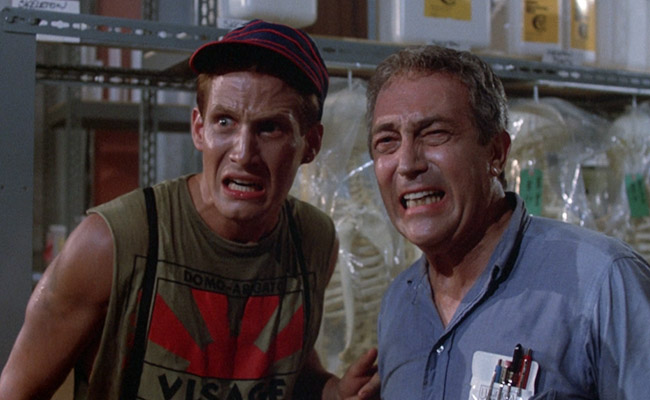
- August 16 – The Return of the Living Dead (USA, Hemdale)
- August 16 – Volunteers (USA, HBO Pictures)
- August 16 – Year of the Dragon (USA, Dino De Laurentiis Company)
Key Exchange, based on Kevin Wade’s play of the same name, was to have starred Jamie Lee Curtis and Mel Damski but deals fell through. Original stage actors Brooke Adams and Ben Masters reprised their roles. Daniel Stern was to have starred in the original stage production but dropped out to make Diner.
Dan O’Bannon made his directorial debut with The Return of the Living Dead. The zombie film is noted for introducing concepts such as the zombies specifically eating brains and being invulnerable to gunshots to the head. The film had its roots in the novel Return of the Living Dead, by John Russo, which was to serve as a follow-up to George Romero’s Night of the Living Dead. When the two parted way, Russo retained the rights to any titles featuring Living Dead. The film was originally to be produced in 3D and directed by Tobe Hooper, but funding was difficult and Hooper backed out to make Lifeforce, which was co-written by O’Bannon, who was then brought on to polish the script and was offered the director’s chair. The story’s chemical ‘2-4-5 Trioxin’ from the ‘Darrow Chemical Company’ was a play on the Dow Chemical Company’s ‘2,4,5-T Dioxin’, better known as Agent Orange.
Volunteers was in the works for six years before it was actually produced. The director of the Peace Corps at the time, Sargent Shriver, felt the film was ‘spitting on the American flag’ and demanded changes. The changes were never made and by the time the film was released, Shriver was no longer director and Peace Corps officials were willing to endorse the film. The film marks the reunion of Tom Hanks and John Candy, who both appeared in Splash. Hanks also reconnected with Rita Wilson, whom he had met while working on an episode of Bosom Buddies. The two would eventually marry.
To keep costs down, most of Year of the Dragon was filmed on soundstages where a full scale reproduction of Manhattan’s Chinatown was built at De Laurentiis Studios in Wilmington, North Carolina. A week before production was to begin, a hurricane destroyed most of the set, which had to be hastily reconstructed. The sets were realistic enough that even Stanley Kubrick was fooled after seeing the film’s premiere. The film earned Golden Globe nominations for Best Supporting Actor – Motion Picture (John Lone) and Best Original Score. It also received five Razzie nominations for Worst Screenplay, Worst Picture, Worst Director, Worst Actress and Worst New Star (both for Ariane Koizumi).
1995
- August 18 – Butterfly Kiss (UK, British Screen Productions)
- August 18 – Mortal Kombat (USA/Canada, Threshold Entertainment)
- August 18 – The Baby-Sitters Club (USA, Beacon Pictures)
- August 20 – Richard III (Brazil, Bayly/Paré Productions)
Butterfly Kiss first opened in Germany on July 6, 1995, and was released in the US on April 26, 1986. Richard III was released in the US on December 29, 1995.
Butterfly Kiss is also known as Killer on the Road.
Paul W.S. Anderson was hired to direct Mortal Kombat based on his debut film Shopping. Anderson had no experience with special effects, but was enthusiastic about making the film and read every book he could on visual effects. Sharon Stone, Christina Applegate and Dina Meyer were originally considered for the role of Sonya Blade. Cameron Diaz was cast but dropped out due to a wrist injury and was replaced with Bridgette Wilson. Wilson had initially been passed over for the role and accepted a role in Billy Madison, so she had to fly to the set the morning after her last day of filming Billy Madison. The character Johnny Cage was based on Jean-Claude Van Damme’s Bloodsport character, and Van Damme was offered the role but he was busy with his own videogame adaptation, Street Fighter. Tom Cruise, Johnny Depp and Gary Daniels were also considered for the role, which ultimately went to Linden Ashby. The role of Rayden was offered to Sean Connery, who did not want to do a physically demanding role so Christoper Lambert was cast. Danny Glover was also considered. The director of Cage’s latest film within the film was to have been a cameo by Steven Spielberg, but scheduling conflicts forced him to back out. Steve James was to play Jax, but he died of pancreatic cancer a year before production was to begin. Michael Jai White was his replacement, but he left to star in Tyson, though he would go on to play Jax in the web series Mortal Combat: Legacy. Gregory McKinney got the role in the film. Anderson encouraged the cast to ad-lib much of the film’s dialog. The cast also had several weeks of fight training, although Bridgette Wilson had to learn on-set due to her last minute casting. Despite the intense fight sequences, and the actors doing most of their own stunts, there were only a few minor injuries, among them a bruised kidney for Ashby and a dislocated shoulder for Wilson, which was fine after it was put back into place.Liu Kang actor Robin Shou fractured two ribs but didn’t tell anyone for fear of shutting down production. He asked Reptile actor Keith Cooke to not hit him on the right side of his rib cage, finished the scene and went to the hospital.
Rachel Leigh Cook makes her film debut in The Baby-Sitters Club.
Shakespeare’s Richard III film adaptation moves the play’s setting to 1930s Great Britain, with Richard depicted as a fascist plotting to take over the throne. The film earned two Oscar nominations for Art Direction and Costume Design. It also received five BAFTA nominations, winning for Costume Design and Production Design. Ian McKellan received a Golden Globe nomination for his performance.
2005
- August 17 – Supercross (USA, Tag Entertainment)
- August 17 – Wah-Wah (Brazil, Scion Films)
- August 18 – Look Both Ways (AUS, Hibiscus Films)
- August 19 – Heidi (UK/USA, Piccadilly Pictures)
- August 19 – Red Eye (USA/Canada, BenderSpink)
- August 19 – The 40-Year-Old Virgin (USA, Apatow Productions)
Wah-Wah received a limited US release beginning on May 12, 2006. Look Both Ways received a limited US release beginning on April 14, 2006.
Wah-Wah was the directorial debut of Richard E. Grant, who also wrote the screenplay based on his own childhood experiences. Grant’s first meeting with a producer took place in 1999. Rachel Weisz, Toni Collette, Meg Ryan, Emmanuelle Béart, Ralph Fiennes and Jeremy Irons all turned down roles. Julie Walters was the first actor to be cast.
Cillian Murphy was so enthusiastic for one of the lead roles in Red Eye that he flew in to meet the producers two days before his wedding.
The 40-Year-Old Virgin was Judd Apatow’s directorial debut. Apatow cast Steve Carell as the title character after seeing his performance in Anchorman, which Apatow produced. The two wrote the film together, based on a sketch Carell had created with The Second City. Casting for the film began early and the script was tailored to the actors’ strengths. Catherine Keener was the first choice for the female lead, and Stormy Daniels was cast due to her comfort with the nude scenes. Large portions of the dialog were improvised, and Apatow would yell ‘Reload’ instead of cut, leaving the film running to capture all of the improvised moments. Over a million feet of film was used, a milestone reached on the last day of production, with Technicolor SA providing champagne to celebrate the moment. Universal halted production after the first week as they felt Carell’s character looked like a serial killer, the footage was not funny, Paul Rudd was called overweight, and the studio didn’t like how Apatow was treating it as an independent film. Universal also refused to allow Apatow to include a supporting role for Jason Segal. Test audiences found the film uncomfortably dirty and not all that funny, and actor Romany Malco begged to have his part cut because his mother was an ordained minister. Apatow refused because Malco was funny, and his mother ended up taking her entire congregation to see the film, several times, the film changing the trajectory of his career with more job offers without auditions. Carell’s chest waxing scene was authentic, with five cameras capturing the moment in one take. Carell insisted it wouldn’t be funny if it wasn’t real. Malco had to leave the set as he began to feel sick during the waxing. His chest was not fully waxed, and he shaved the rest off three weeks later. After blurting out Kelly Clarkson’s name during the process, Clarkson told Seth Rogan that was the one thing people would know her from no matter what else she did. Rogen had come up with the idea while seeing her on TV as he compiled a list of ‘clean jokes’ and ‘dirty jokes’ for the scene.
2015
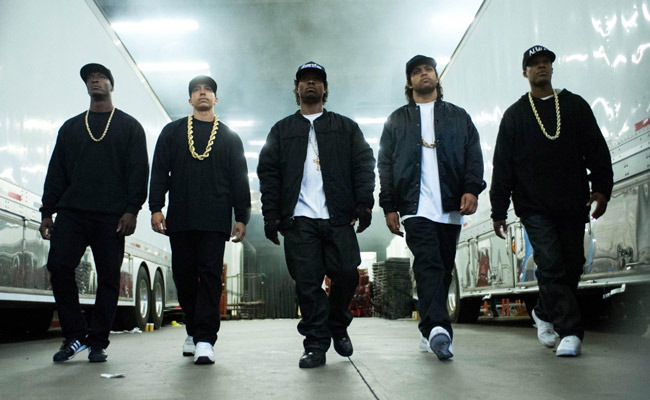
Universal Pictures-Legendary Pictures
- August 14 – Absolutely Anything (UK, Bill and Ben Productions)
- August 14 – Fort Tilden (USA, Orion Pictures)
- August 14 – Straight Outta Compton (USA/Canada, Universal Pictures-Legendary Pictures)
- August 19 – Hitman: Agent 47 (Philippines, Daybreak Productions)
- August 19 – Sinister 2 (France)
Absolutely Anything first opened in Brazil on February 13, 2015, received a limited release in Canada on April 1, 2016, and was released in the US on May 12, 2017. Hitman: Agent 47 was released in the US and Canada onAugust 21, 2015. Sinister 2 was released in the US and Canada on August 21, 2015.
Absolutely Anything featured the voices of John Cleese, Terry Gilliam, Eric Idle, Terry Jones, Michael Palin and Robin Williams, marking the first time the surviving members of Monty Python had worked together since 1983’s Monty Python’s The Meaning of Life. It was also their first time working together since the death of Graham Chapman in 1989. It was the last film for both Terry Jones, who died in 2020, and Robin Williams in a main role, released the year after his death.
O’Shea Jackson Jr. portrays his father, better known as Ice Cube, in Straight Outta Compton. Lil Eazy-E was rumored to be playing his father as well, but the role went to Jason Mitchell. The film was originally announced in March 2009 for New Line Cinema, but by 2013 Universal Pictures had picked it up. The film received an Oscar nomination for Best Original Screenplay.
Hitman: Agent 47 was the directorial debut of Aleksander Bach. Paul Walker was attached to star, but died in a car accident before production had started. Rupert Friend replaced Walker as Agent 47.