Amblin Entertainment
Many more movies were released in the first half of the century this week, while the later decades gave us fewer titles but more ‘blockbusters’ for the summer season. Films of note this week include a 1945 documentary that was filmed illegally, as well as a horror film featuring the final dual appearance of two horror icons, and a drama that gave its star her first non-singing role. One 1985 film brought a popular action character back to the big screen, and a second film saw its star play his lead role for the last time. 1995 had an Oscar-winning Best Picture, and a film that featured the first CGI lead character. 2005 gave us an animated film set on an island, and 2015 gave us an ill-advised remake of a horror classic, and an ill-advised attempt to bring a theme park attraction to life. Scroll down to see all of the films released this week across the decades, and tell us if any of your favorites are celebrating milestone anniversaries.
1925
- May 23 – Painted Daughters (AUS, Australasian Films)
- May 24 – Raffles, the Amateur Cracksman (USA, Universal Jewel)
- May 24 – Satan’s Sister (UK, B.W.P. Films)
- May 24 – The Fighting Demon (USA, Richard Talmadge Productions)
- May 24 – The Rainbow Trail (USA, Fox Film Corporation)
- May 24 – White Fang (USA, Robertson-Cole Pictures Corporation)
- May 24 – White Thunder (USA, Ben Wilson Productions)
- May 25 – Going the Limit (USA, Paul Gerson Pictures Corporation)
- May 25 – Old Home Week (USA, Famous Players-Lasky Corporation)
- May 25 – Unrestrained Youth (USA, Lee-Bradford Corporation)
Painted Daughters and Satan’s Sister have no known US theatrical release dates.
Lost films: Old Home Week
Unknown status: Raffles, the Amateur Cracksman, Satan’s Sister, The Fighting Demon, The Rainbow Trail, White Fang, White Thunder, Going the Limit, Unrestrained Youth
Only a portion of Painted Daughters survives today. The film was part of an attempt to make world-class films for the international market. To accomplish this, the studio imported director F. Stuart-Whyte from Scotland. During production, £600 worth of completed footage was stolen from the production office. The thief turned out to be a young boy and the film was returned.
Satan’s Sister is an adaptation of the 1921 novel Satan: A Romance of the Bahamas by Henry De Vere Stacpoole, which was later adapted again as the 1965 film The Truth About Spring.
White Fang was produced as a starring vehicle for Strongheart, a German Shepherd actor who appeared in a number of films in the 1920s.
1935
- May 24 – Murder in the Fleet (USA, Metro-Goldwyn-Mayer)
- May 24 – People Will Talk (USA, Paramount Pictures)
- May 25 – In Caliente (USA, Warner Bros. Pictures)
- May 25 – Justice of the Range (USA, Columbia Pictures)
In Caliente is also known as Viva Señorita. Busby Berkeley choreographed the musical numbers, which included the hit song ‘The Lady in Red’.
1945
Metro-Goldwyn-Mayer
- May 23 – Three’s a Crowd (USA, Republic Pictures)
- May 23 – Topaz (USA, Dave Tatsuno)
- May 23 – Where Do We Go from Here? (USA, Twentieth Century Fox)
- May 24 – Thrill of a Romance (USA, Metro-Goldwyn-Mayer)
- May 25 – Molly and Me (USA, Twentieth Century Fox)
- May 25 – The Body Snatcher (USA, RKO Radio Pictures)
- May 25 – The Clock (USA, Metro-Goldwyn-Mayer)
- May 27 – China’s Little Devils (USA, Monogram Pictures)
Topaz was filmed illegally at Topaz War Relocation Center in Utah by internee Dave Tatsuno, with the help of members of the camp staff, to document life at the camp during World War II. At the time, 8mm cameras were considered contraband for Japanese Americans and were to be surrendered to the US government. Tatsuno gave his camera to a friend to avoid confiscation, and with the help of store supervisor Walter Honderick he managed to get the camera into the internment camp by having it mailed to Honderick to avoid inspection. Because of Tatsuno’s experience in retail, he was allowed to travel outside of the camp and across the country on merchandise runs. During these trips, he acquired the 8mm film for his camera. To have the film developed, he would have it sent to Salt Lake City, and then to his brother attending the University of Utah. The film was only the second amateur film to be selected for preservation in the National Film Registry. A version of Tatsuno’s color home movies runs 48 minutes but does not include any of his commentary. An eighty minute black-and-white version is available to the public that does include Tatsuno’s commentary.
Where Do We Go from Here? was Kurt Weill’s only musical written directly for the screen. The mock-operatic scene ‘The Nina, the Pinta, the Santa Maria’ was one of the longest musical sequences ever filmed at the time. Co-stars June Haver and Fred MacMurray met while making the film and were later married. Joan Leslie’s singing voice was dubbed by Sally Sweetland.
Thrill of a Romance is also known as Thrill of a New Romance. It was the second of five films to pair Esther Williams and Van Johnson. The paint used to give the swimming pool water the right shade of blue began to dissolve after the chlorine was added, resulting in a mess with the consistency of homogenized milk, requiring the pool to be drained and refilled. When filming the backstroke scenes in the swimming pool, Williams had to place her hand under Johnson’s back to keep him afloat.
The Body Snatcher was the last film which featured both Boris Karloff and Bela Lugosi. Producer Val Lewton worked on the screenplay under the pseudonym Carlos Keith.
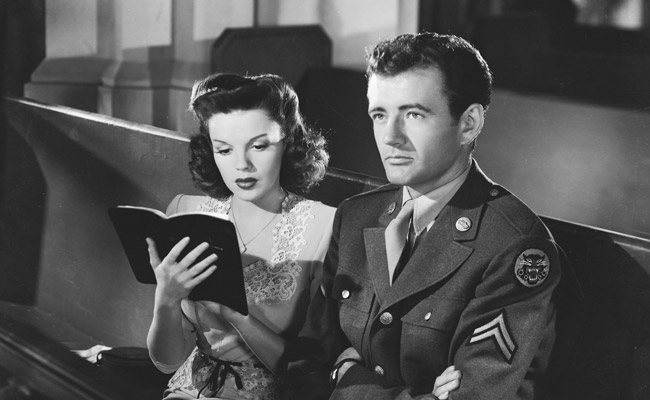
The Clock was Judy Garland’s first dramatic role, and the first starring vehicle in which she did not sing, at her request to have a break from the strenuous process of making a musical. It was sixteen years before she had another non-singing role. Fred Zinnemann was the originl director, but was removed at Garland’s request due to a lack of chemistry and disappointing early footage. She requested her Meet Me in St. Louis director Vincente Minnelli to replace him. The two had a hit with that film and had started a romantic relationship, which was rekindled while working on The Clock. They were engaged by the end of production. Both Garland and Robert Walker suffered personal issues while making the film. Garland became more addicted to prescription drugs as the studio pressured her to control her weight and pep her up. Walker learned his wife Jennifer Jones was having an affair with David O. Selznick, and spiraled downward, with Garland often finding him drunk in a Los Angeles bar, sobering him up overnight so they could appear before the cameras the next day. As World War II had not yet ended at the time of production, filming in New York City — the film’s third character — was impossible due to costs, and was shot entirely on the MGM lot in Culver City, California. Minnelli had a replica of the Waiting Room at Penn Station built on a soundstage at a cost of $66,450.
China’s Little Devils is also known as Little Devils, and is one of a number of films featuring the exploits of the Flying Tigers. The film also included sequences from 1942’s Flying Tigers as well as the Curtiss P-40 mockups used in that film. Most of the filming took place on studio backlots.
1955
- May 24 – The Magnificent Matador (USA, Edward L. Alperson Productions)
- May 25 – Soldier of Fortune (USA, Twentieth Century Fox)
- May 26 – Love Me or Leave Me (USA, Metro-Goldwyn-Mayer)
The Magnificent Matador features an early appearance by Stuart Whitman. Budd Boetticher claimed he had written the film for Anthony Quinn, who had won two Oscars and couldn’t get a job. The original, now unknown title was changed by the studio to The Magnificent Matador, which Boetticher hated.
The screenplay for Soldier of Fortune by Ernest K. Gann attracted the interest of John Wayne, who had just starred in Island in the Sky and The High and the Mighty, both also by Gann. Fox won the rights to the story after Clark Gable, who had a deal with the studio, asked them to purchase the rights. Susan Hayward signed to play the female lead, but was going through a divorce and could not bring her children to Hong Kong. She was allowed to film all of her scenes in Hollywood, with Gable and a double filming on location. In one scene, they walk through a doorway in Hong Kong, and Gable and Hayward enter the building interior set in Hollywood. David Niven was to play the police inspector, but decided he didn’t want to go to Hong Kong, so he was replaced with Michael Rennie. Filming in Hong Kong lasted for five weeks.
Ava Gardner turned down the lead role of Ruth Etting in Love Me or Leave Me, and was placed on temporary salary suspension by MGM as punishment. Doris Day took the role. The film earned six Oscar nominations, including Best Actor for James Cagney, winning one for Best Motion Picture Story.
1965
- May 23 – Two Left Feet (UK, Roy Ward Baker Productions)
- May 26 – War-Gods of the Deep (USA, Bruton Film Productions)
Two Left Feet has no known US theatrical release date.
War-Gods of the Deep was released in the UK as City Under the Sea. It was the final film for director Jacques Tourneur. The UK title was drawn from Edgar Allan Poe’s poem ‘The City in the Sea’, attempting to capitalize on the Poe films of the era, and like them only loosely based on the poem. The film was also loosely based on H.P. Lovecraft’s novella The Shadow over Innsmouth. Charles Bennett’s script was heavily rewritten in Britain when AIP refused to pay his way. He called it ‘the worst thing I was ever involved with’. Louis M. Heyward admitted to rewriting the script to add humor, in particular the addition of the comic chicken and the character played by David Tomlinson.
1975
- May 22 – Breakout (USA, A Persky-Bright/Vista Presentation)
- May 22 – The Wind and the Lion (USA, Herb Jaffe Productions)
- May 23 – Lepke (USA, AmeriEuro Pictures)
Breakout first opened in West Germany on March 7, 1975. Prison scenes were filmed at Fort de Bellegarde in France, with Romani people (aka gypsies) standing in for Mexicans, as Mexico would not participate in the making of the film, which was loosely based on an actual event that took place in August 1971. Michael Ritchie was the original director but he didn’t like the idea of the female lead being played by star Charles Bronson’s wife, Jill Ireland. Bronson threatened to quit if Ireland wasn’t cast, so Tom Gries was the replacement director. The film was notable for giving Bronson a more comedic, lighthearted role.
The Wind and the Lion was John Milius’ second film as director. It was a co-production by MGM and Columbia Pictures. Milius wanted Omar Sharif and Faye Dunaway for the leads, but Sharif refused the role and Dunaway became ill due to exhaustion. Sean Connery and Candice Bergen were cast. Milius didn’t get along with Connery, though he liked his performance, and he felt Bergen’s acting range was limited and was only concerned with looking good. Milius also wanted Orson Welles to play newspaper magnate Charles Foster Kane, the same character he played in Citizen Kane, but the studio refused, fearing RKO would sue. Instead the real life Willam Randolph Hearst, upon whom Kane was based, was used. The film earned two Oscar nominations for Original Score and Sound. Milius’ screenplay was also nominated by the WGA.
1985
Eon Productions
- May 22 – Brewster’s Millions (USA, Davis Entertainment)
- May 22 – Rambo: First Blood Part II (USA/Canada, Estudios Churubusco Azteca S.A.)
- May 24 – Here Come the Littles (USA, DIC Entertainment)
- May 23 – An Indecent Obsession (AUS, PBL Productions)
- May 24 – A View to a Kill (USA, Eon Productions)
An Indecent Obsession has no known US theatrical release date. Here Come the Littles first opened in Luxembourg on January 8, 1985.
Brewster’s Millions was the seventh film based on the 1902 novel of the same name by George Barr McCutcheon. Peter Bogdanovich was slated to direct a version of the story in 1983, which was the most similar to the 1945 version but the project languished in development hell. When Universal greenlit the film two years later, Bogdanovich was no longer involved, and Walter Hill was hired even though he’d never directed a comedy before. The fictional baseball park in the film was actually a leftover set from the TV series Bay City Blues.
James Cameron and Sylvester Stallone wrote the screenplay for Rambo: First Blood Part II. Cameron was also writing The Terminator and Aliens at the same time. Cameron’s first draft was titled First Blood II: The Mission, which had the same story structure but was more violent. Producers wanted John Travolta to play Stallone’s sidekick, but Stallone vetoed the idea. Lee Marvin turned down the role of Marshall Murdock, which went to Charles Napier. During filming, special effects man Clifford P. Wenger, Jr. was accidentally killed during one of the film’s waterfall explosions, when he lost his footing and fell to his death. The film earned an Oscar nomination for Sound Editing, and seven Razzie nominations, winning four: Worst Picture, Worst Actor, Worst Screenplay, Worst Original Song.
Here Come the Littles was adapted from John Peterson’s series of novels, and was also based on the ABC television show of the same name. An Indecent Obsession was originally intended to be a TV movie.
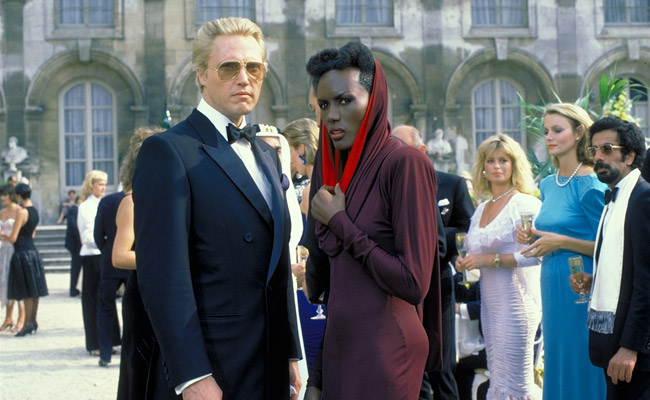
A View to a Kill is the fourteenth official entry in the James Bond movie series, and Roger Moore’s seventh and final appearance as the MI6 agent. It was also the last to feature Lois Maxwell as Miss Moneypenny. The title comes from Ian Fleming’s 1960 short story, ‘From a View to a Kill’, included in the For Your Eyes Only anthology, but has an entirely original screenplay. The story was originally envisioned as an episode of an abandoned 1958 CBS James Bond TV series. From a View to a Kill is how the film is promoted at the end of Octopussy in the ‘James Bond Will Return’ credit. The theme song by Duran Duran was the only Bond theme to hit Number 1 on the Billboard Hot 100 chart, and it earned a Golden Globe nomination for Original Song. It’s rumored that Maud Adams cameoed as an extra in the Fisherman’s Wharf scene, but she cannot be clearly identified. If the rumor is true, it would be her third appearance in a Bond film. This is the first Bond film to carry a disclaimer at the beginning of the film due to the fictional company in the movie, Zorin, having a name too close to an actual company in the US, Zoran, with the disclaimer assuring audiences the film’s company had no relations to any real-life companies. The role of Zorin was to be played by David Bowie, but he decided he didn’t ‘want to spend five months watching my stunt double fall off cliffs.’ Sting was then offered the role, which he turned down, and Christopher Walken took it. Priscilla Presley was to play Stacey Sutton, but had to bow out due to her contract with Dallas. Tanya Roberts was given the role, and earned a Golden Raspberry Award nominations for Worst Actress. Barbara Bach was to reprise her The Spy Who Loved Me role of Major Anya Amasova but she turned it down, forcing the creation of an entirely new character, Pola Ivanova, played by Fiona Fullerton. Patrick Macnee became the fourth former star of The Avengers to appear in a Bond film, following Honor Blackman, Diana Rigg and Joanna Lumley. The character of Felix Leiter was rewritten as a new Asian-American character to capitalize on the film’s San Francisco setting. Dolph Lundgren has a cameo in the film as one of General Gogol’s KGB agents because he was visiting girlfriend Grace Jones on the set and was asked if he’d like to be in the film.
1995
- May 23 – Vacant Possession (AUS, Wintertime Films)
- May 24 – Braveheart (USA, Icon Entertainment)
- May 24 – Tales from the Hood (USA, 40 Acres & A Mule Filmworks)
- May 25 – Everynight … Everynight (AUS, Siren Visual Entertainment)
- May 26 – Casper (USA/Canada, Amblin Entertainment)
- May 26 – Johnny Mnemonic (USA, Alliance Communications Corporation)
- May 26 – Mad Love (USA, Touchstone Pictures)
Vacant Possession and Everynight … Everynight have no known US theatrical release dates. Johnny Mnemonic first opened in Japan on April 15, 1995.
Terry Gilliam was offered to direct Braveheart, but he declined. Mel Gibson was initially only interested in directing and considered Brad Pitt for the role of Sir William Wallace, but he reluctantly agreed to play the role himself. Jason Patric was also under consideration. Sean Connery was approached to play King Edward, but had to refuse the role due to other commitments. Gibson’s Icon Entertainment had difficulty getting funding for the film, and Warner Bros. made an offer on the condition Gibson made another Lethal Weapon movie, but he refused. To help lower the budget, Gibson employed the same extras to play both armies. 1,600 members of the Irish Army Reserve had been given permission to grow beards for their roles. Gibson had to tone down the violence to avoid an NC-17 rating, and Paramount chief at the time, Sherry Lansing, asked that he cut his 195 minute film down to 177 minutes. Gibson has offered to reassemble his original 4-hour cut if co-funders Fox and Paramount were interested. The film earned 10 Oscar nominations, winning five: Best Picture, Best Director, Best Cinematography, Best Makeup, and Best Sound Effects Editing. It also received seven BAFTA nominations, winning three, and four Golden Globe nominations, winning one for Gibson’s direction. Despite the film’s success, it has been criticized for its many historical inaccuracies.
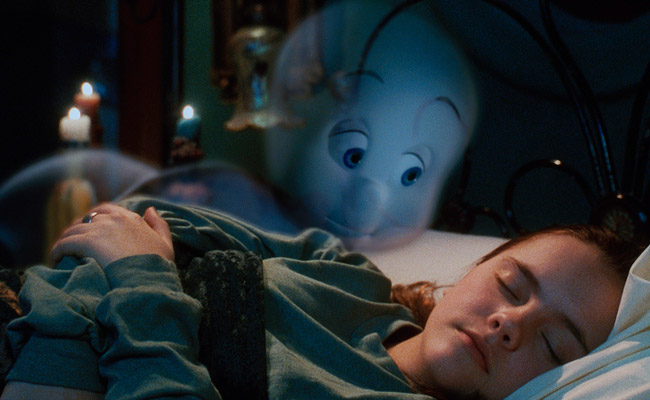
Casper was the feature film directorial debut of Brad Silberling. Producer Steven Spielberg hired him after seeing an episode of Brooklyn Bridge, which Silberling had directed. Alex Proyas had originally signed to direct but left due to creative differences with the screenplay. J.J. Abrams did an uncredited rewrite on the script. It is the first film to have a fully CGI character in a lead role. One 90-second scene with Casper and Christina Ricci took eight months to create. Devon Sawa plays Casper in his human form. The film features several celebrity cameos including Don Novello as Father Guido Sarducci, Dan Aykroyd in an uncredited appearance as Ray Stantz from Ghostbusters, Clint Eastwood, Rodney Dangerfield, Mel Gibson, and Jon Kassir as the voice of the Cryptkeeper.
Johnny Mnemonic was the feature directorial debut of Robert Longo. William Gibson, author of the original 1981 short story, wrote the screenplay. The film was shot in Canada with Toronto and Montreal standing in for Newark and Beijing, respectively. The film originally had a $26 million budget, but Sony wanted to retool it as a blockbuster after the success of Speed, which also starred Keanu Reeves, with casting changes and script rewrites forced on Longo and Gibson. The studio ultimately recut Longo’s film without his involvement resulting in a final product that did not reflect his artistic vision of a story full of irony, now a mainstream action film. A black-and-white version of the film was released in 2022, Johnny Mnemonic: In Black and White, which was closer to Longo’s original vision. Longo had wanted to shoot in black-and-white but the studio refused. Eight minutes of additional footage featuring Takeshi Kitano and Takahasi was filmed for the Japanese release.
Major cuts were made to Mad Love by the studio including the removal of darker subject matter about mental illness and teen suicide, and reducing character Casey’s behavior down to mere depression rather than the fact that she suffered from bipolar disorder.
2005
- May 25 – Madagascar (Philippines, DreamWorks Animation)
- May 27 – The Longest Yard (USA, Happy Madison Productions)
Madagascar was released in the US on June 24, 2005. The story was developed over two years in order to finalize the four main characters. The penguin characters in the film were originally created for a different animated film, Rockumentary, in which they were a Beatles-esque rock band. When that project was scrapped to due music rights issues, co-director Tom McGrath revived the penguins for Madagascar as a commando unit. The character of Julien was originally a minor role with two lines, but after Sacha Baron Cohen’s audition in which he improvised an Indian accent and eight minutes of dialogue, the character was rewritten to be the more prominent ‘King of the Lemurs’.
The Longest Yard is a remake of the 1974 film of the same name starring Burt Reynolds, who also appears in the remake. Reynolds earned a Razzie nominations for Worst Supporting Actor for this film and The Dukes of Hazzard.
2015
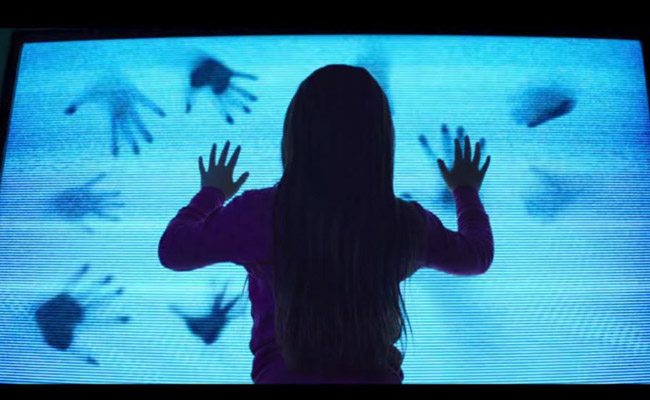
Ghost House Pictures
- May 22 – Poltergeist (USA/Canada/UK, Ghost House Pictures)
- May 22 – Tomorrowland (USA/Canada/UK, Walt Disney Pictures)
Poltergeist is a remake of the 1982 film of the same name. The project was originally announced in 2008 but ended up in development hell. The project was revived in 2012. A fourth Poltergeist film had originally been announced in 2003 to be titled Poltergeist: Kayeri, which would ignore the events of Poltergeist III. Original stars JoBeth Williams and Craig T. Nelson were approached to reprise their roles, while the Carol Anne role had to be recast due to the death of Heath O’Rourke. Nelson officially boarded the project in 2005, and Hilary Duff was in consideration for Carol Anne. In 2007, the studio decided to move in a new direction with the sequel, and commissioned a new script to be titled Poltergeist: In the Shadows, but that project stalled and a direct remake of the original was announced in 2008 for release in 2010, which got pushed to 2011 due to the tight schedule and MGM’s financial woes. By 2012, new producers and a new script put the film back on track, and in June 2013, 20th Century Fox came on board to co-produce and distribute the film. Tom Cruise and Richard Armitage were considered for the role of Eric Bowen before Sam Rockwell was cast.
Tomorrowland was known as Tomorrowland: A World Beyond in the UK, and Project T in other regions. The film is based on the Tomorrowland section of the Disney theme parks. The film’s working title was 1952. Director Brad Bird had been tapped to direct Star Wars: Episode VII, but turned it down for Tomorrowland. Designs of Space Mountain and Spaceship Earth were incorporated into the film. Bird suggested the traditional Disney production logo at the start of the film replace the castle with the Tomorrowland skyline. Judy Greer’s role in the film was cut to a minor cameo to streamline the runtime, while Lochlyn Munro’s part was cut completely. It was the first film to be released in the Dolby Vision format for Dolby Cinemas. Due to Disney’s trademark on the word ‘Tomorrowland’, the American version of the Tomorrowland music festival was renamed TomorrowWorld.